Header Image

Showing posts with label Shawn. Show all posts

Friday, August 19, 2016

Westbennetteren 20: The Quest for 20 Percent

After a 3 month primary brawl, using almost 5lbs of sugar, I cracked 20% and created a beast of a beer!

After breaking such a massive barrier I'm briefly sneaking out of my blogging retirement to tell the story of how it came to be.

The Road There
The road to what became Westbennetteren 20 was a long and winding one.  It started in 2013 during an evening of beers and games.  I clearly remember at least two of the people at the table being Daniel Fernandez (of Beancurdturtle Brewing and BCT Brewing Project fame) and Miklos Somogyi.  During the evening the subject of quads came up and we had a discussion on the evolution of the trappist styles along with what the next logical step would be.  Logically the argument was for it to be called a Quintuple (or The Quint as Miklos would refer to it over the next few years) and be in the mid-teens abv wise.

Over the next few years I would think about brewing it, even occasionally putting it on deck. During this time I would toy with the recipe trying to think both of what I wanted it to be and how I would push it into the abv range.   One of my initial recipes had doubling the amount of candi syrup I use in the boil for Westbennetteren 12. During this time I firmed up in my mind that this beer would be more of a supped up quad than anything else.  

Eventually I moved away from just trying to overload it with candi syrup in the boil and instead moved towards step feeding it pure dextrose in primary.  This is the technique used in brewing Black Tuesday, 120 Minute IPA and several others.  I ended up adapting the methodology Scott over at Bertus Brewery used for his DogFish 120 IPA clone with the base recipe being my Westbennetteren 12.  Additional notes on brewing massive beers. 

With the recipe firmed up and after two back to back years of disappointing batches of Westbennetteren 12 (b3 stalled fermentation followed by a slight infection, b4 flat) I decided that the time to brew the quint had arrived.

The Journey Begins 
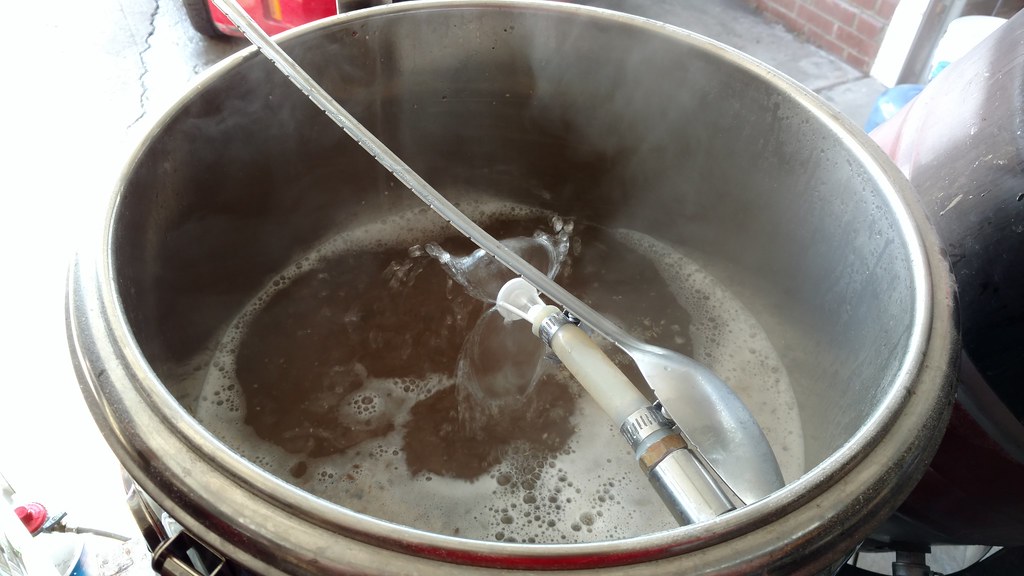
On Sunday, March 6, 2016 I set out early in the morning to brew essentially Westbennetteren 12 for the fifth time.  Overall it was a smooth brewday.

After some discussion on brewday and thinking about it in more depth I've decided that Westbennetteren 20 isn't a Quintuple after all, it's actually something more.

To start with let's take a look at the progression of "trappist" style beers.

Single 4-6% ABV pale in color
Dubbel 6-7.5% ABV dark in color
Tripel 7.5-9.5% ABV pale in color
Quad 9.5-13% ABV dark in color

The pattern that emerges is that odd numbered beers are pale while even numbers are dark with deep red, brown and garnet hues. There is also a pattern in the abv range with little overlap. Between the high range of a quad and the lowest abv I targeted for Westbennettern 20 (18% to 22%) there's 5 percentage points up for grabs. Based on that here is my proposed expansion of trappist styles 

Single 4-6% ABV pale in color
Dubbel 6-7.5% ABV dark in color
Tripel 7.5-9.5% ABV pale in color
Quad 9.5-13% ABV dark in color
Quintuple 13-18% ABV pale in color 
Westbennetteren 20 18-22% dark in color

As far as style names go there are actually 2 options sextuple or hexatruple
Given the fact I'm probably making many a monk roll over in their grave I'm going with Westbennetteren 20 - The Hex (hexatruple)

The Battle Rages
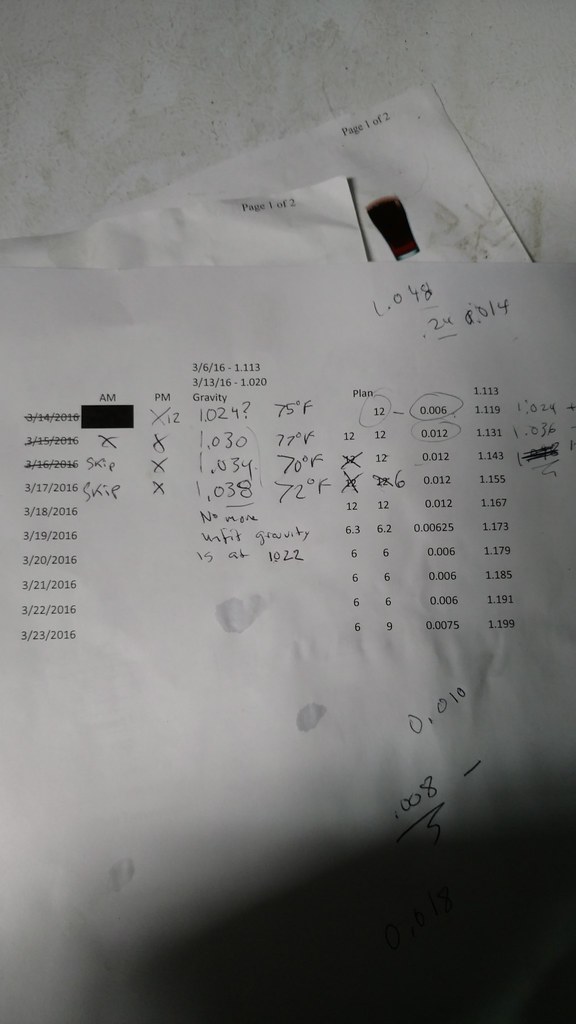
Fermentation started out fine and within a week it had gone from 1.113 to 1.024.  At this point (14 March 2016) I pitched the first starter of WLP099 (Super High Gravity Ale Yeast) along with 12oz of dextrose and some pure O2. My plan out of the Bertus methodology had been to pitch 12 oz of sugar morning and night till it slowed down then moving over to 6 oz additions till it reached the target range. The expectation is that the yeast consumes the sugar at a rate equal to what you are adding. I would check gravity nightly using cleaned and sanitized equipment so that I could add the samples back after measurement. 

It became clear pretty quickly that I was adding gravity points faster than the yeast was consuming them.  For the 5th addition I moved from 12oz to 6oz to see it that would help, it didn't.  During the first 5 days I'd added 54.2 oz of dextrose with the gravity increasing to 1.041. So while it was consuming the sugar, gravity would have been up to 1.051 if it hadn't been, it wasn't consuming it nearly fast enough.  At this point I stopped adding sugar and moved gravity checks to every couple of days.  My plan was to resume adding sugar once it reached 1.026.  

Alas it completely staled out at 1.030 for over 3 weeks.  At this point the accumulated OG was 1.140 and calculated alcohol only 17.1%.  Too low for me to stop yet not to mention at 1.030 was a little too sweet.

To kick it back into gear I ended up repitching twice - the first was another starter of WLP099 with an additional 12oz of sugar.  Unfortunately it didn't get very far and ended up stalling for another month at 1.035.

Not long after, during a meeting of The Fellowship of Tao Brewers at my place we sampled it and discussed my plight.  Afterwards I took in all the advice I was given and formulated a cure for my situation. 

The Cure

The cure consisted of pitching a liter starter made with 2 packages of Champagne yeast and several capsules of Servomyces. At pitching I also included another couple capsules and some fresh O2 for good measure. I took gravity a couple of days later and it had dropped to 1.026 ~ 18.7% abv.  With some solid fermentation progress I decided resume slowing feeding it another 12oz.  This took me to a accumulated OG of 1.152. 

Final Gravity
On June 11th, just a touch over 3 months since the brewday, it hit 1.020. After some back and forth texts with Shawn I set the fermentation chamber to 30°F to cold crash the yeast and stopped the fermentation! Using the advanced gravity formula 1.152 to 1.020 came out to be 20.7% abv. 

I lagered it for 2 months to help it clear before I forced carbbed it for bottling as I didn't have any confidence it would bottle condition.

The Conclusion 

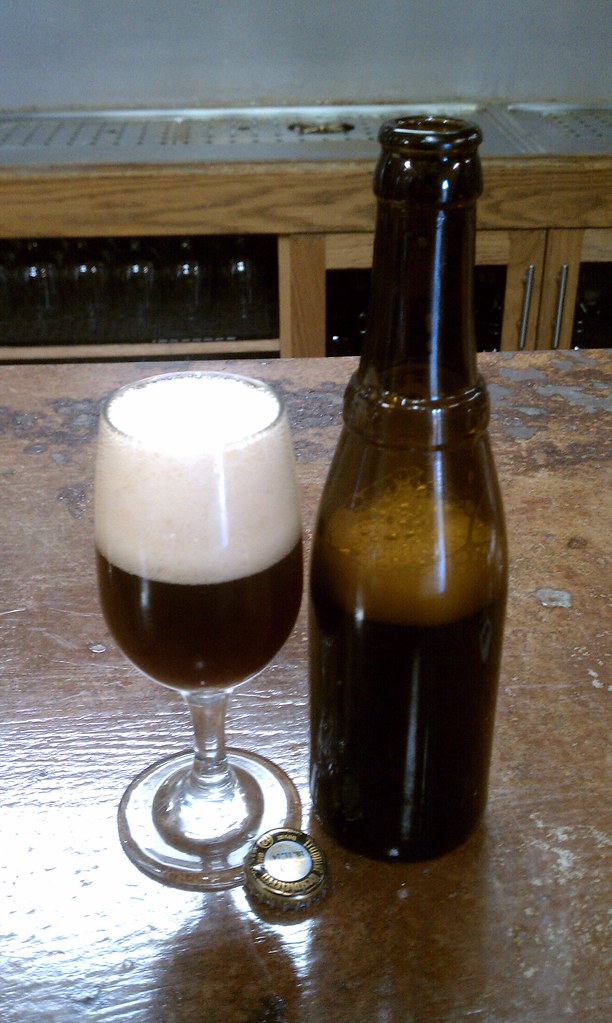
The last change I made from Westbennetteren 12 was to change the color of the cap.  With Westbennetteren 12 being directly inspired by Westvleteren 12 I'd always used gold caps from Bottle Mark. For Westbennetteren 20 I optied to go with SNB "house colors" of red and black, a combo that worked within the existing Green Blue Gold Westvleteren cap color scheme.

Lessons for next time.
- Start with 6oz of sugar per feeding and ensure it gets consumed before adding more
- Keep the upper temp below 82 (one of the reasons it could have stalled is I might have cooked the yeast in the upper 80s) 
- Use Servomyces at second pitch
- Drive the FG lower to the 1.014 range, it was still going when I cold crashed it and I find it a little sweet (something which might mellow with age) 
- More hops to help counteract the sweetness. 

Now that it's all wrapped up it gets a couple months to even out before I share them (1 or 2 might have already slipped out).  If we do a QuadFest 2016 I debut a couple bottles then, if not I'll have a private celebration to release them

Cheers

- SNB

Recipe and Instagram Pictures Below the Break


Thursday, January 9, 2014

#QuadFest2013

New Font for 2013 
Last December (of 2012) I wrote a recap of QuadFest 2012, a get-together tasting that my friends Daniel, Shawn and myself had a put together in order to try a series of quadruples that we had brewed at the start of that year.  We all felt that it was a very fun and successful event that we wanted to do again next year.  We also decided that we wanted to expand the field of participants by extending invitations to brewers whose beers we've enjoyed in the past and run it through our Fellowship of Tao Brewers Google group.    
We presented the idea of QuadFest 2 - the Quadening, along with a style presentation on brewing quadruples at the January meeting of Tao.  It was met with a lot of positive feedback and interest so I started a new discussion topic for QuadFest 2013 the next day.

The guidelines for new participants were very simple; brew a quad that quarter (sooner the better to give it time to age), bottle it in later summer, come to QuadFest 2013 and have a great time.  There was no set recipe to follow but I included the presentation on quads with some “tips” along with my recipe for Westbennetteren 12 b1.  I still think the recipe would be incredibly easy to convert to extract.  We used the thread all year as a place holder for recipe development, feedback, advice and planning.

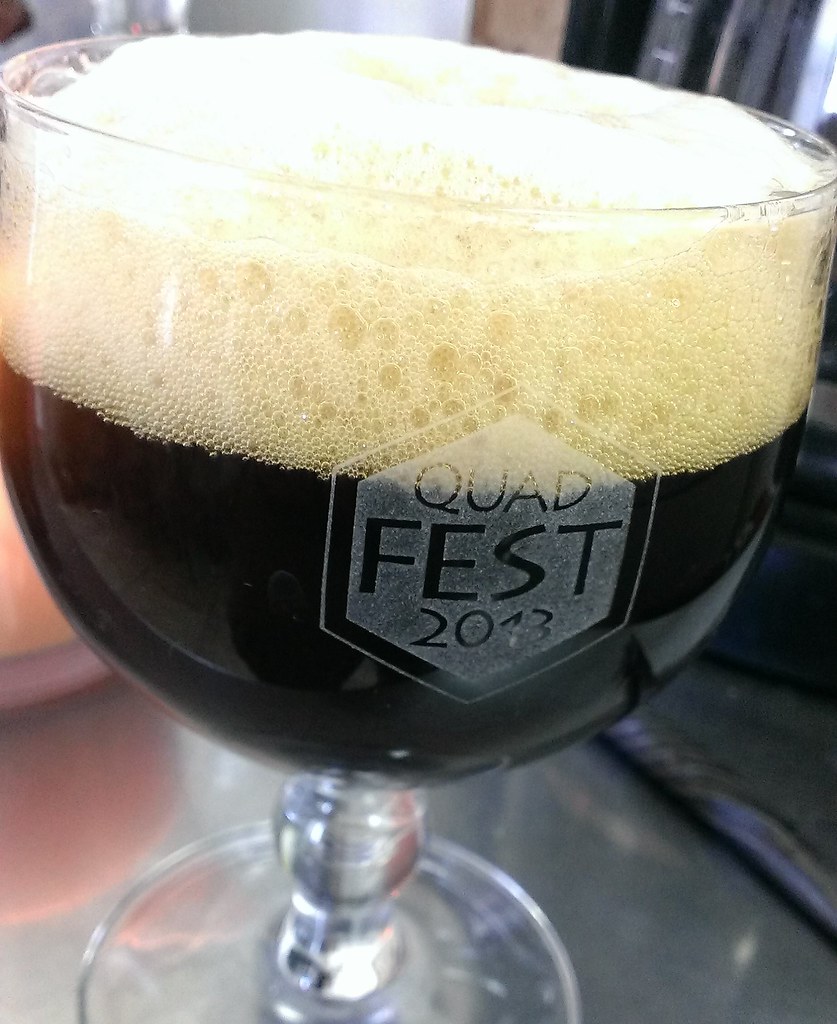
The QuadFest 2013 Chalice!
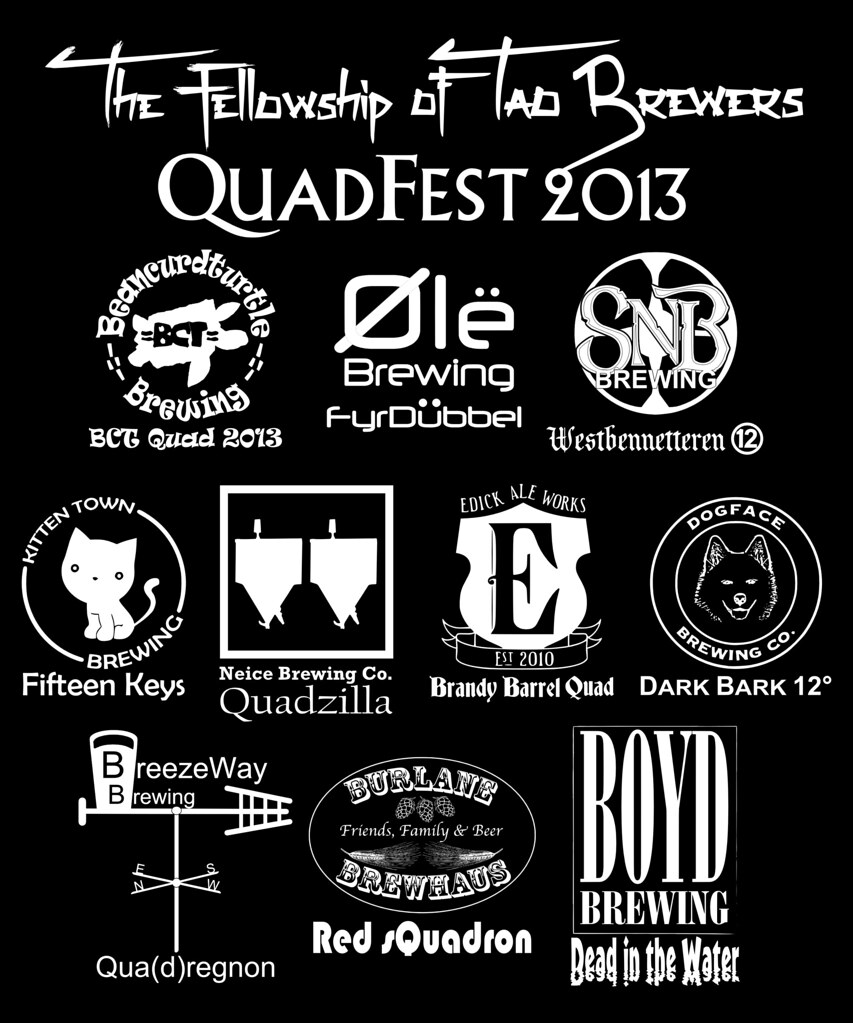
As QuadFest 2013 approached I scrambled to finish some pretty slick participant shirts giving them free range over color and logo set (I had started over the summer but my new job zapped my time).  Daniel also had a set of chalices made with both the QuadFest 2013 logo and the Fellowship of Tao Brewers logo.  The chalices came out incredible taking the silly seriousness of QuadFest to the next level. Once more the Globe hosted us and ended up reserving front tables just to fit us all in as we ended up increase participation to 10 quads and expanded the number of people in attendance to 18 which for once included my wife which made me very happy.  We divided the quads into two flights; Classic (pils/2-row with candi syrup) and Belgian Dark Strong (inclusion of specially malts). Before each one Daniel presented a commercial example for calibration.

In the order presented
SNB Brewing - Westbennetteren 12 - 11.1% - Classic
Kitten Town Brewing - Fifteen Keys - 9.0% - Classic
Burlane Brewhaus - Red sQuadron - 9.5% - Classic
Dogface Brewing Co - Dark Bark 12 - 9.5% - Classic
Neice Brewing Co - Quadzilla II – 13.0% - Classic
Boyd Brewing - Father of Dead in the water – 10.0% - BDS
BreezeWay Brewing - Qua(d)regnon – 10.7% - BDS
Ølë Brewing – Fyrdübbel – 9.9% - BDS
Beadcurdturtle Brewing - BCT Quad 2013 – 10.3% - BDS
Edick Ale Works – Brandy Barrel Quad – 16.0% - BDS
The line up of 10 incredible beers
10 excellent quads from 10 excellent brewers, each one was nicely executed and delicious but still 10 quads… So where do QuadFests go from here?  I’m concerned that we might have outgrown the Globe for next year as we continue to expand. In addition sampling 10 quads is a tough job but I think with a more structured setup we can maybe handle about double that many next year.   

Next year I see QuadFest 2014 going through another expansion in its original format, but with a few slight changes: Early requirements for how much will be needed for QuadFest (3-4 x 750mls) for better planning come bottling. Set the date further in advance, possibly over the summer. Find a new venue to allow for a more focused event with better lighting, I’m hoping we can convince Brad over at Peace to both participate and host. QuadFest 2015 will happen but only time will tell what form it will take.

#QuadFest2014!

Cheers

-SNB

Saturday, November 30, 2013

The Pilz that Killz (Pilz Brothers Collaboration)

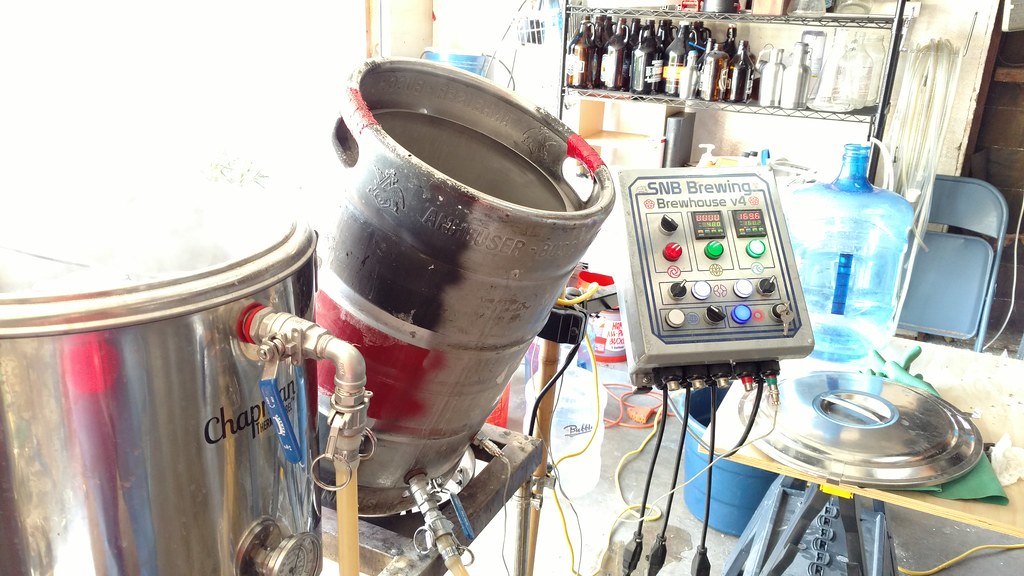
I know it's been a while since I've update the blog and there are a lot of reasons for that.  The biggest is my new job that has kept me a lot busier than I had been in the past.  The other big reason for the lack of posts has been a lack of brewing.  A couple months back I took the plunge to start construction of an all new brewhouse.  The project is taking slightly longer than I would like and since I stripped several pieces of my old set up for the new one the result has been an out of commission brewery.  Hopefully the project can get back on track in December...

Meanwhile, I've been having the itch to brew as the last time I actually produced a beer was the last time I brewed with my mentor and good friend Shawn O on the Same Grain, Same Style, Different Brewer group collaboration which produced my Sour Citra Saison. Shawn and I had been talking for several months about going a Bohemian Pilsner using decoction, I even bought a sack of grain in August time frame just for it. Unfortunately scheduling the actual collaboration proved to be about as easy as building a brewhouse.

When it was looking like we were going to brew in October I bought a vial of WLP800 (Pilsner Lager) to use seeing as how it had a mid November expiration, however by the time we nailed down a post Thanksgiving brewday I needed to buy another vial.  Stock issues lead me to grab a vial of WLP830 (German Lager).

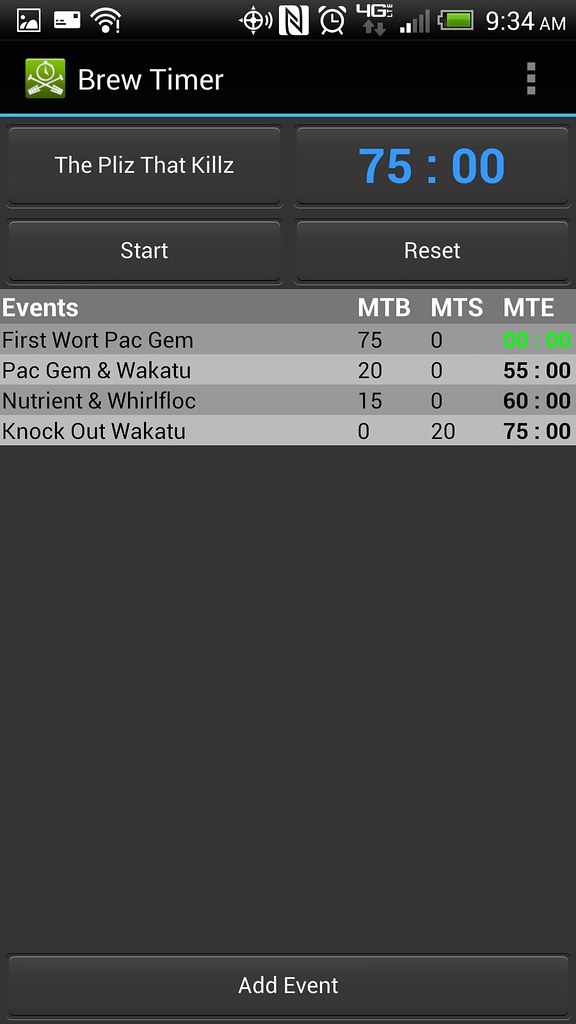
For hops I went out on a limb and used two New Zealand hops one of which I'd never heard of.  For bittering and half of my flavor charge I went with Pacific Gem. For the other half of flavor and a larger whirlpool of Aroma I selected Wakatu.  Here are the descriptors

Pacific Gem - New Zealand 
Alpha: 15.00 % Beta: 8.20 %
Usage: Bittering 
High alpha smoothcone cross developed at DSIR in 1987.
Used for: Bittering - produces a cask-oak woody flavor.
Aroma: Pleasant - some blackberry aroma.
Wakatu - New Zealand 
Alpha: 9.00 % Beta: 8.50 %  
Usage: Dual
Characterized by restrained floral notes atop freshly zested lime Description: Formerly called Hallertau Aroma. Similar to German Hallertau but Higher alpha. Excellent Dual Purpose hop, rounded floral aroma with hints of lime.
Typical Beer Styles: Lager, Pils, Bock, Wheat, Kolsch, Helles, Belgian Ales.
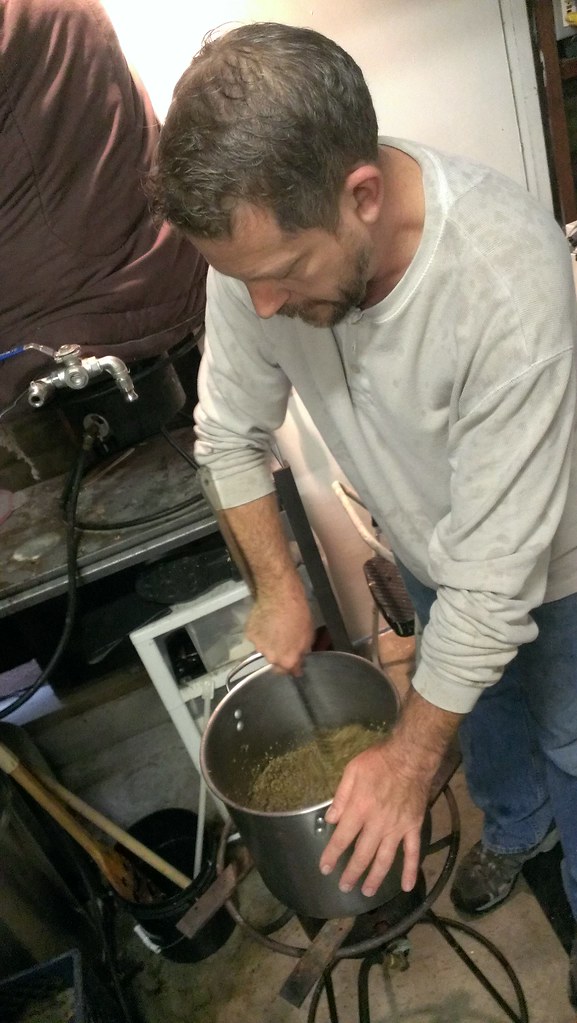
The one thing I really wanted to use was my new 15 Gallon Boil Kettle with Tangential Inlet I bought from Brewers Hardware back in October.  The thing was an absolute beast!  Once we sparged into Shawn's kettle we drained off half of it into mine and started heating.  I was amazed at how fast it came to a solid boil. The tangential inlet also worked better than I could have imagined and after a 30 minute whirlpool had created a wonderful island of trub in the center of the kettle.

I'm really looking forward to trying this one in a couple of months and can't wait till my brewhouse is completed.  For our next collaboration / Scott education project we are looking at doing a turbid mash to brew some lambics.  Until next time.

Cheers

-SNB

Monday, August 5, 2013

Sour Citra Saison - Same Grain Same Style Different Brewers No.1

The OG beer signal 
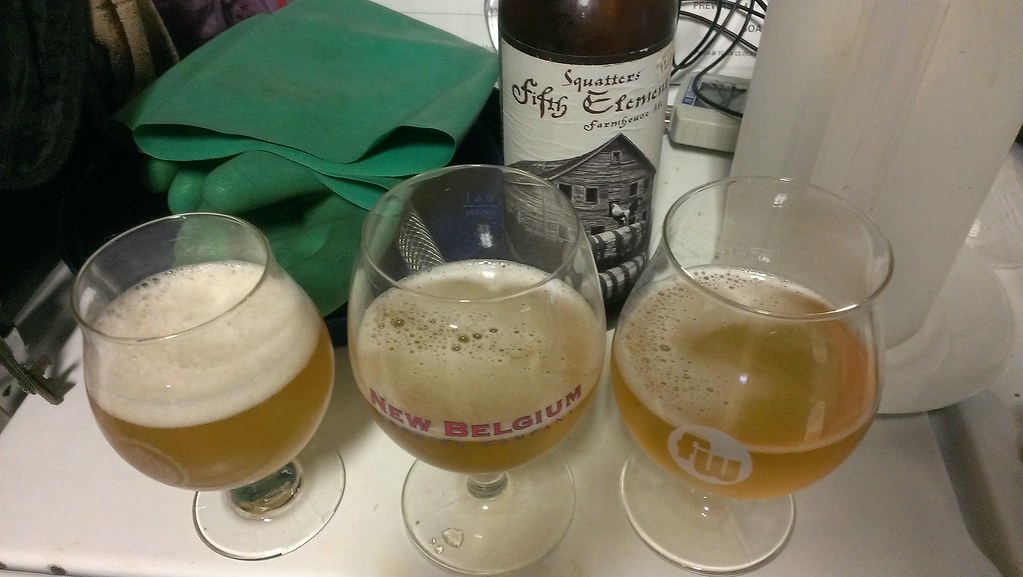
A few months back Steve J and Daniel F came up with the idea for "a different kind of 'collaboration'". One that involved brewing the same style of beer and the same grist percentages.  After that, every other aspect (gravity, hops, yeast/bugs, spices etc) was up each brewer. The style for what I am assuming/hoping will be the first of many rounds was determined to saisons. The grist percentages were set at 86% Belgian Pilsner, 11% Spelt and 3% Rye As I've mentioned before saisons aren't my favorite style as they tend to have a wide range of flavor and aroma profiles considered to be "in style" however certain saisons, such as Fifth Element from Squatters, are among my favorite all time beers.

I knew right away that I wanted to team up with Shawn O on this one.  My idea for how I wanted to collaborate with Shawn was pretty simple, 1 mash and 2 kettles.  Basically do the mash for around 11 gallons of wort production and split it into two kettles.  This would allow each of us total control on hops, spices etc.   Initially I figured that he would brew a clean to version while I would sour it in some way.  It quickly became apparent that he also wanted to play around with some bugs, which I was in no way surprised by.  

After a couple of weeks of swapping ideas between each other over various conversations, calls, texts and emails we settled on plan of attack.  Each of us would do our own sour starter which we would combine and add to the mash when we got together.  I would take 6 gallons of wort and add 1.5 gallons of RO with a 60 minute boil targeting a 1.048 SG. Shawn would take the balance adding slightly more RO and do a 90 minute boil looking have 1.037/8 SG.

If you are going to brew a sour saison...
To prep for brewday I made a gallon starter with pilsner DME which I split between two vessels.  The first vessel was a quart mason jar with a half a cup of raw unmilled grain. This became my sour starter as lactobacillus is naturally present on the hulls of grain.  I tried my best to keep it at 120°F using an old Polystat Constant Temperature Circular I had rescued from the trash at work.  Unfortunately the reason it was tossed was that it couldn't cool, which at the time I wasn't concerned about, however as I learned this meant that it would continue to drift up over time.  I was able to remedy this by setting an upper limit which shut it off if it was above, this was accompanied however with a nice alarm. The remaining gallon became the start for an old pitch of ECY04 Brett Blend #1
ECY04 Brett Blend #1 - Three individual Brettanomyces isolates from lambic producers combined to give an aggressive brett presence in any beer. Vigorous, funky, and acid-tolerant, the blend can be added at any stage of fermentation and is excellent for priming or re-yeasting. Contains B. anomala, B. clausenii and B. anomulus
A new saison that I approve of
For the hops I decided I wanted a BIG Citra presence so I planned to hop burst with a good amount of at 20 and 0 while keeping the IBUs contrained (more pale ale level than IPA).  For the bittering hop I decided to go with some Cascade given it's dual use potential.

Brewday itself was a blast.  I headed over very early to find the mash water almost at temp and Shawn waiting for me to mill.  After getting everything set to go we tasted and tested our sour starters.  Both had a pleasant sour bite and combined for a 3.63 pH so we tossed the liquid into the mash.  My brother Ryan (who recently moved to Cali from MN) soon arrived to hangout and help me brew.

In the end we both beat our target gravity with me coming in at 1.051.  It was great to brew with Shawn again as every time I do I learn so much.  The beer is currently fermenting in a poor-man fridge and smells absolutely incredible, I can't wait!

Santé 

-SNB

Monday, February 25, 2013

Westbennetteren 12 b2

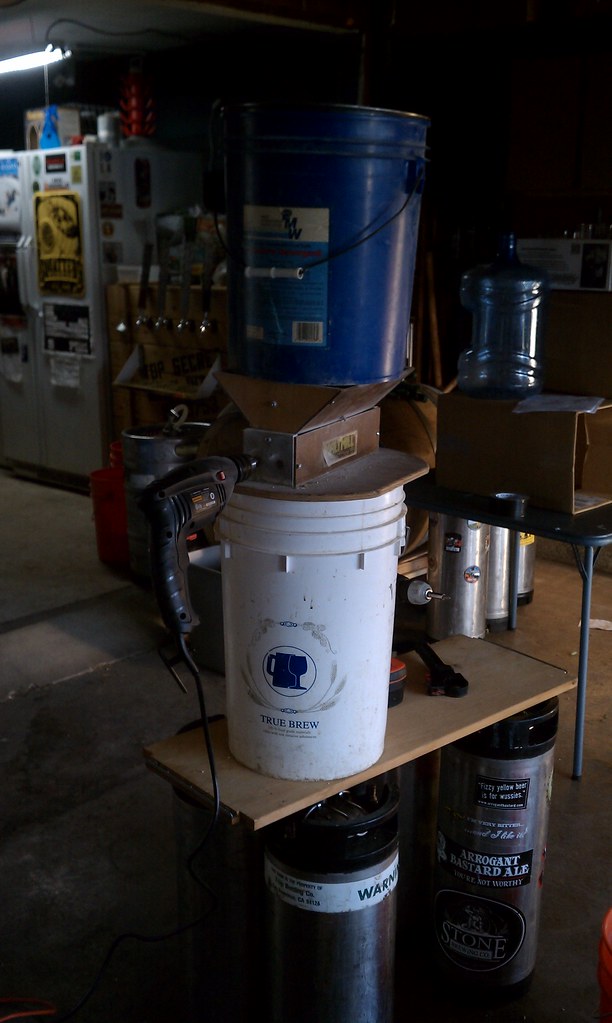
I got a corded drill to help me mill
Over a year ago I set out to brew my first Belgium Quadrupel aka quad which I tongue-in-cheek called Westbennetteren 12. Not only did it become one of best beers I've brewed (in my opinion) but helped to kick off QuadFest along with Shawn and Daniel.  If you recall from the post we had such a good time we already started planning the 2013 event. To make the date I needed to get brewing!

According to my notes from QuadFest 2012 
I'm very pleased with how it came out.  Lots of nice dark stone fruit flavor.  Great character from the yeast. Slightly high level of carbonation but not as bad as I had feared.  Similar to the Westvleteren but not as dead on as I was hoping for. It was definitely a little darker and the taste was close but not right there. I had another bottle of it the next day and took some notes for a tasting analysis. Next year I'll follow some of Daniel's advice and simplify the grain bill even more going straight up plisner.
I decided after reviewing Daniel's recipe (which was actually pretty similar to mine) to keep the split between pale and plisner the same. Last year I think I ended up using US grain (despite my notes saying Bel) because it's special order at the shop as I found out when I tried to get Pale Malt (2 Row) Bel so I ended up using some of the 2 row I had on hand (I do love buying grain by the sack). 

A rainbow of flavor
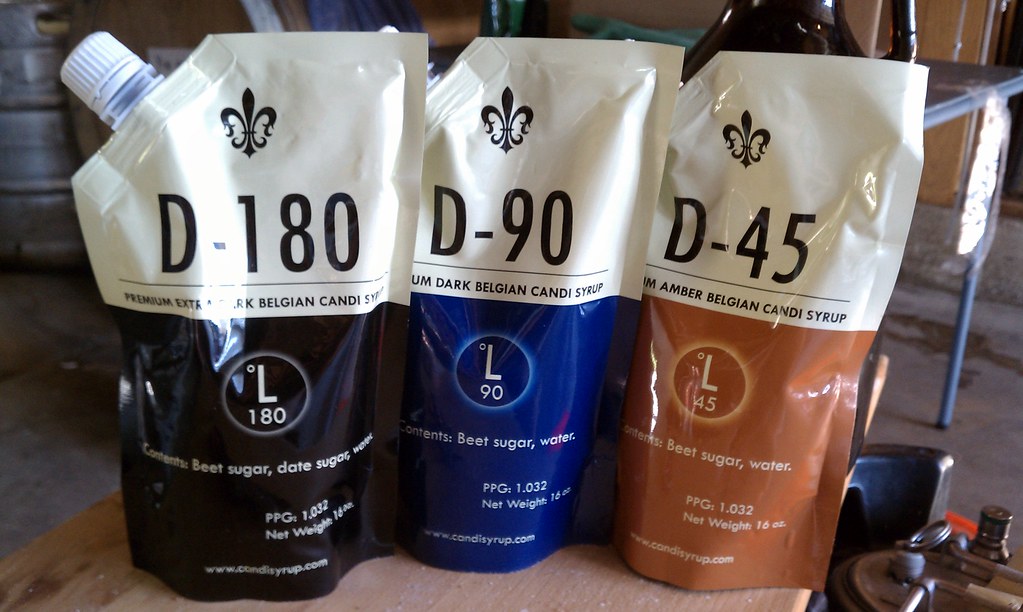
For the sugar portion I again sought out syrup from Candi Syrup Inc. In order to lighten in up and modify the flavor slighty to try and get it more in line with Westvleteren 12 I changed the amount of D-180 from 2 lb to 1 lb and made up for it by adding a pound of D-45.  So my order to Candi Syrup Inc was pretty much one of every syrup they offered (I use Simplicity to prime) with the exception of Golden.

If I recall the logic behind my hop schedule from last year I might have grabbed the Northdown thinking that they were a sub for Goldings which I couldn't find.  This year I was able to find some Goldings so I made that switch.

I briefly toyed with the idea of using East Coast Yeast Trappist Ale (ECY13) but between price, availability and time I decided to stick with good old WLP530 Abbey Ale from White Lab.  To build the projected 336.3 billion yeast cells needed I made a 6 pint starter and tossed it on my stir plate a few days in advance. For some reason BeerSmith 2 stops calculating yeast cell build after 4 pints (which ended up at 465.9 billion) so I know I was nicely north of the required amount.

As before when it came to temperature I took to the mid 80s for the initial fermentation.  I actually got there a little fast (oh no) due to some issues with the balancing act as ask my fermentation cube to do for warming beers. I got it under control and will start lowing it as soon as it enters the below 1.020 range.  After that it will be a nice 6 months of bulking conditioning at lager temps.

Cheers

-SNB

Friday, January 18, 2013

Putting the "Yin" in the Barrel

Barreling Filling Fun
Shortly after putting together the post for the Red Wine Barrel Aged Baltic Porter I posted up a link to it on the Tao of Fermentation with the statement - "The Tao barrel project - really needs a code name". It wasn't long before Daniel pointed out that "Yin is shadow, represented by the black side of the Yin/Yang symbol. We can call this one Yin. Then if we ever make a Witbier or something in a Chardonnay barrel like Chris brought up, that would be Yang." Not only did this statement seem to name the beer it also has the added effect of getting the ball roll on the next group brew, a Golden Strong, and the search for a Chardonnay barrel to put it in.

After a little over a month in primary it soon became time to transfer the beer to the barrel. As a child of the 80s I decided to take advantage of the date and aim for the 13th minute of 13th hour of the 13th day of the 13th month of the 13th year aka 13/13/13 13:13 aka Smarch 13th 2013 and damn if the Smarch weather wasn't ever in full effect later that night.

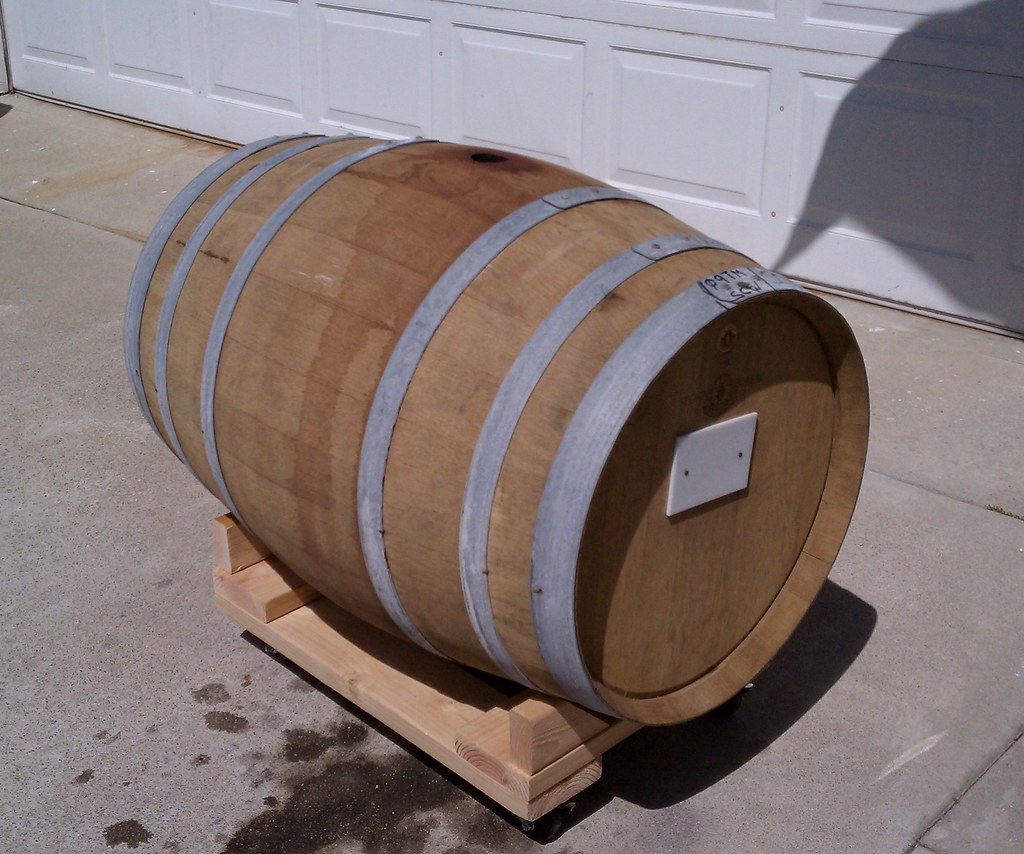
To prep for the transfer I had a number of things to do.  First and foremost I had to construct a movable wine barrel rack. If you take a look at the barrel pictured in the Sour Seven posts you can see the rack Shawn built following directions he found on Vinesugar. For my barrel rack I decided to utilize a flat dolly I already had (which I was using for a TV so that I could roll it outside over hot summer days).  Bonnie helped me test out whether or not the dolly would support the barrel.  To convert it into something that could further support a full barrel, I devised a system of cut wood boards of various sizes.  I made sure to align some of the main supports underneath the metal straps holding the barrel together.  On top of this I put two flexible wood boards that would cradle barrel.

CO2 to push beer into the barrel
After I had built the rack it was time to prep the barrel for the beer.  To do this I made up a 15 gallon batch of HOT star-san and put it in the barrel.  I then went out to my front yard, set my phone for 15 minutes and rolled the barrel back and forth the length of my front yard.  This included flipping the barrel end over end for a couple of laps.  The goal was to make sure that the barrel was both water tight and that the sanitizer had the ability to get into every part of the barrel.

Once Shawn arrived we went over everything we had and started to formulate a plan of attack which we somewhat had when Daniel arrived a little bit later. The first order of business was to sanitize the tubes, the problem was that I had literally used every-last drop of star-san I had on barrel prep.   It wasn't a big deal as we just emptied the barrel into a tub which we then emptied into my mashtun.

Once we had everything ready we moved the pump and tubes over to the Beast to start the transfer.  It seemed to go a lot faster than it did for the sour seven and in no time we we're prepping to rack the beer from Chris' keg.  It was actually a pretty easy setup requiring only some CO2 to push the beer into the barrel.  Daniel had brewed up another 5 gallons to help top off however a miscalculation on my part over the size of the barrel meant that we were still short so I filled the head space with a blanket of CO2. 

Very interesting beverage
The current gravity is around 1.033, higher than we want it but not bad attenuation considering we started around 1.100.  I'll give it a couple of months to really soak up the intense red wine from the barrel before I start a monthly tasting on it.  I don't think I'll top it off more than once (if that) and just let the angels have their share.

One final note, speaking of Shawn he recently started back up his blog Brewnundrum.  If  you are interested in the scientific side of brewing I highly recommend checking it out.  The current topic is Aeration Revisited in which he splits a single wort into 4 fermenters and then oxygenated them via 4 different methods. Once done he compared the results and actually changed his own preferred method based on the results. Very cool. 

Lots of photos after the jump.

Cheers 

-SNB

Monday, January 14, 2013

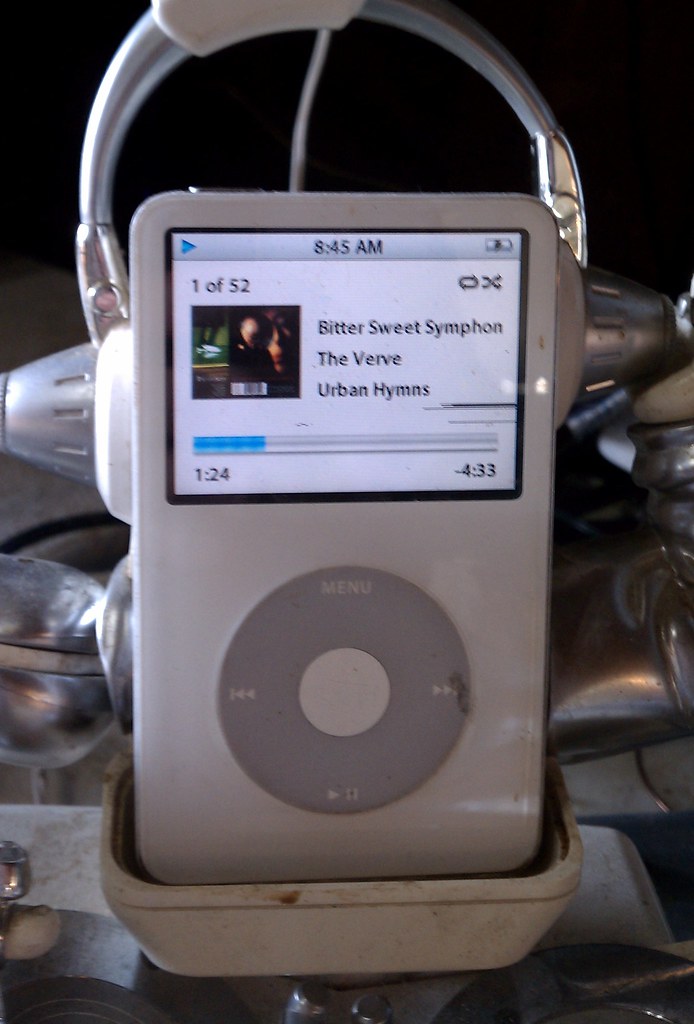
Bitter Sweet Symphony

I created a Bitter Sweet Symphony
iTunes Genius playlist to listen to
It needed A LOT of editing
Every couple is suppose to have a "song" and I assume most of the time it's probably some happy-sappy love song.  That's not the case for Bonnie and I.  We first started dating in December of '97 while going to University of Puget Sound in Tacoma Washington. This happened to be right around the time when a little song called Bitter Sweet Symphony started getting airtime on the main alternative station I listened to. There was something about that song that we both really identified with which lead to it getting some pretty heavy playtime on my computers playlist.  It soon became apparent that it was our song, which was fortunate as given the time and young love it was something that could have gone very wrong.    Bonnie notes: "I have a lot of memories associated with that song and time in our lives; eating your special sandwich from the sub (the student union building), snuggling in the worlds smallest bed, hanging out in your dorm room etc."

So what does any of that have to do with beer?  Here's the story, I'd been thinking of retooling the BIG IPL recipe for a while, really spinning the concept of a Single/Double IPL into a new beer, but had not really been inspired by anything. Well, one day I was in the car listening to an old CD and rockin out to Bitter Sweet Symphony (which I often do) when it hit to me.  Bitter Sweet Symphony would be an incredible name for a beer, especially a hop heavy one like an IPL.

As soon as I had the name recipe ideas started flying through my head; would it be a IPA or IPL? Double of Single? What about an American Double Stout? For a while I had narrowed it down as a single IPL with the hop schedule of Sydnie IPA with the grist of BIG IPL scaled down.  That idea pretty much hit a brick wall one evening while I was enjoying a pint of Surly Abrasive.  The massive Citra flavor and aroma hit me like a freight train - Bitter Sweet Symphony needed to be a Citra forward IPL.  I knew that I had tons of Citra stockpiled so I hit the internet to see if I could any reasonable Abrasive clone recipes to use as a foundation to build Bitter Sweet Symphony from.

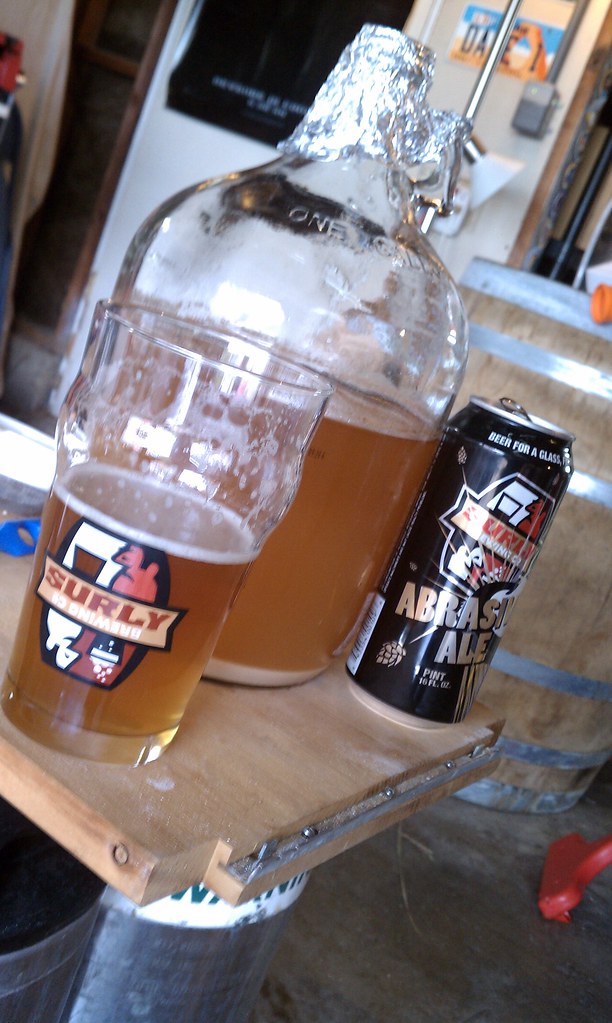
Cracked my last on hand can of
Abrasive to drink during cool-down
I found what looked like a pretty successful attempt on the Northern Brewer forum and with the notes on Abrasive on Surly's website I started to nail down what I wanted to do. I also reviewed the Surly Furious Pro Series Recipe to gain insight on Surly beers.  For base grain I would use the 2-Row I had on hand with a generous helping of Golden Promise.  I'd also included a couple pounds of oat to give it a smooths mouthfeel. To pull a little of my personality and brewing style into the beer I decided that instead of including Crystal malts, which would have been in the form of Crystal 20L, I would use a dash of Carared and in place of the brewers sugar I would use Rice to bump the ABV while keeping it light.  

Days before brewing I came across an interesting discussion on late hopping and the concept behind whirlpooling. The basic premise is to add hops at flame-out whirlpool and let sit for 80 minutes.  I wasn't fully on board with adding 80 minutes to my brewday but figured I would give it a shot with 30 and slowly creep up from there depending on if I'm pleased with the results.

If you saw the horrible chill plate setup that I jerry-rigged together for the 34 brewday you'll be pleased to know that I have gone back and made a few adjustments.  I'm still not fully where I want to be and will soon be picking up a router speed control to slow the flow of fluid through the pumps.  Shawn uses one on his chill plate setup.  Once in place I should be able to have more control over the temperature of the wort. 

I will now leave you with a little entertainment that helped inspire this post.  Recipe and pictures after the break as always.
 

Cheers

-SNB

Thursday, December 27, 2012

Yin - Red Wine Barrel Aged Baltic Porter

60 gallons of high gravity Baltic Porter
With over 8 months of aging on the Sour Seven it was more than time to get Shawn's other red wine barrel, which like it's sister is an old red wine barrel from from Hogshead Wine, into production. Somehow Shawn let me be the Project Manager on this one, probably in exchange for space in my garage to store the barrel.  I mentioned in the Sour Barrel Ale Project post my thoughts on doing a big stout in the other barrel, while at the back of my mind I was thinking of a Baltic Porter.

For the last few months I've been part of a Monthly Share/Evaluation/Advice Meet-up group operating on the code name Tao of Fermentation. It's a loose group of brewers at various experience levels with the goal of seeking critical evaluation on our beer.  It was also the perfect group to get together for a group brew to fill the other barrel.

Good use of my time
Once it became clear Shawn was going to let me take the lead on this one I started steering the project starting at the October evaluation meet-up.  Seeing as how the first barrel had gone straight to being a sour barrel I wanted to try and keep this one clean to began with.  I figured as it developed in the barrel we would have plenty of time to steer it to sour if need be but a clean red wine aged dark beer sounded delicious.

It was also at that meeting that I suggested that we go with a Baltic Porter and asked Daniel if he could help develop the main base beer.  To me Daniel had made some of the best Baltic Porters I'd ever had including one that was the base beer to Black Lingerie. The big problem I was going to run into was controlling the temperature as I planned on doing a group primary in the Beast again. I figured however that by December the crazy weather we'd been having would mellow out and winter would arrive. For the yeast we used some Saflager 34-70 surrey that Shawn had washed from a Bavarian Dunkle he made. In addition I asked everyone to bring a couple extra packs with them to pitch.

By mid November we were set on a December 9th brewday and by the time the day came the forecast looked perfect to do a monster lager. While we had discussed getting together for the brewing it wasn't feasible given the set up of everyone's brew system.  So instead it was decided that people would drop off during the day.

The next morning = more cleaning
It ended up being a pretty mellow brewday, as I didn't race to get up and get started.  While my brewday was mellow it wasn't without it's challenges. My scale was broken which made measuring my bulk 2-row a bit challenging.  While she wasn't overly pleased with it my wife allowed me to use her as the tare on our house scale to weigh out the grain (no I didn't get a picture as I value my life).  I also had a nice little mess to clean up when the hose I was using to recirculate spilled out - it actually happened twice.  In the end I had a measured gravity of 1.110, which is a new record.  Overall the group averaged right around 1.095.

I correctly predicted that people would be dropping off most of the day so I didn't really need a set end time, in fact drop off started just after noon and went until 9ish that night.  I spent most of the time doing odd brewing chores such as kegging up some Imperial Browns that I brewed back in October during a disastrous brewday - so disastrous that I doubt it will ever make it to a post. I also cleaned everything that needed cleaning including a bunch of the draft lines on the Indy Crate

The next day I came out to a massive fermentation from both fermentors.  By the time I got home the blow-off was all over the garage requiring me to change the sanitizer and clean the garage. I tell you my garage has never smelled more like a brewery than it did that week.  One step of caution I took was given the amount of fermentables I was using I knew there would be a massive amount of CO2 output, I therefore kept the garage partially cracked and the door open to create a draft.  CO2 is very dangerous and heavier than air and I did not allow my dog or child in the garage unless it had been fully opened first.

Cheers

-SNB


Updates
Putting the "Yin" in the Barrel
Yin Part Three - Draining the Barrel


Wednesday, May 16, 2012

Sour Barrel Ale Project: Update 1

Transferring the beer to the barrel
Two weeks after the initial brewday for the Sour Barrel Ale Project, I headed back over to Shawn's house to help him transfer 65 plus gallons of beer into the used wine barrel.  50 gallons came from the beast of a fermenter we had built out of a water drum. The other 15 had been fermented in 3 5 gallon buckets to allow us to top off the 65 gallon wine barrel.  After brewday the project became known as the Sour Seven as it took seven of us to brew it up.

A few details on the barrel that I didn't originally cover.  Shawn got it (and its sister) from Hogshead Wine.  It's a pretty old barrel and has seen a lot of use with primarily red wines.  To clean and seal Shawn filled it up with sanitizer and kept it filled to keep it sealed. 

To fill the barrel we re-plumbed Shawn's pump attaching one end with a racking cane.  We started by filling the barrel with the 15 side gallons and about 3 odd gallons of a Brettanomyces (bruxellensis and claussenii) starter Shawn had been working on since brew day.  Once everything was emptied we popped the top of the beast and started transferring it.  In total it took us over 45 minutes to fill the barrel.  Not wanting to fill the barrel completely to the top we were left with around 7 gallons of yeast and trub of which we collected 2 gallons into 2 sanitized gallon jugs.  Collecting the slurry took some thinking but in the end we scoop it out with a sanitized cereal container.

The gravity for the 50 gallon batch ended up around 1.013 with the gravity of the 15 gallons and brett starter being high enough to bring the total up to 1.017 when we pulled a sample from the filled barrel.  In addition to the brett starter Shawn also put together a sour starter that he'll let sour for the next couple of months before using it to top off the barrel.

Cheers

-SNB

Wednesday, April 18, 2012

Sour Barrel Ale Project

The wine barrel from Hogshead Wine
I know I promised an update on my SCHF Split Batch Porter which is well on its way to being BaseCamp Breakfast and BaseCamp Dessert.  I promise I will do an update on them in a week or so when I keg the finished products.  This post will cover a far more exciting project – barrel aging.

A few months ago my brewing mentor Shawn got his hands on a couple of used 65 gallon wine barrels from a local winery.  The idea surfaced to fill one them with a red ale and then pitch a large culture of bugs to create a barrel aged sour ale.  The problem became filling the barrel as 65 gallons is a lot of beer to produce.   Shawn decided to launch a thread on the AHP Brew Club forum to recruit additional brewers.  In total 7 brewers participated.

That's a damn big fermenter
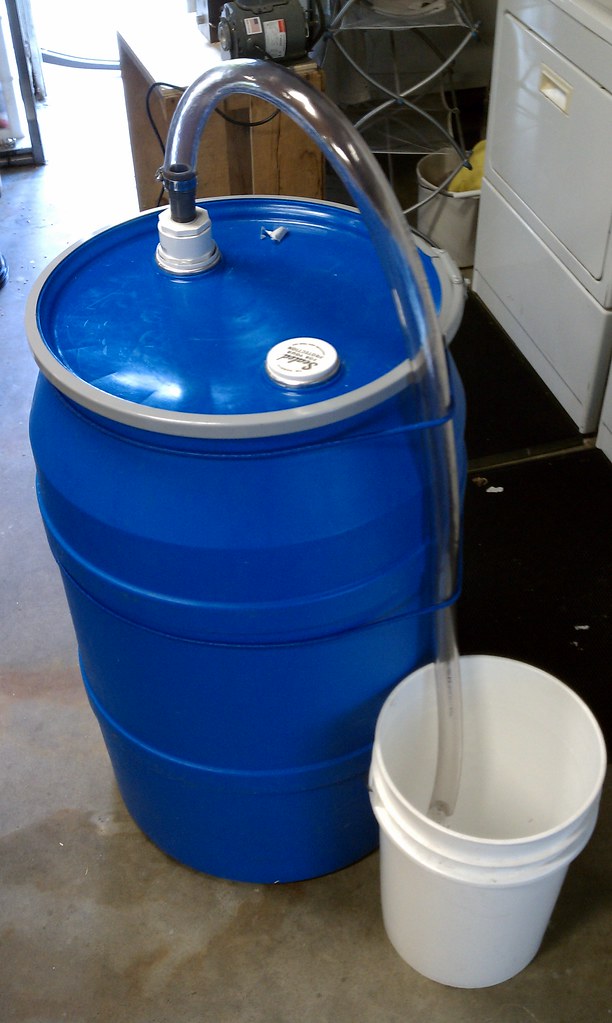
The next question in the fill became how to conduct the primary, this was a question that I had an answer too.  A little over a year ago I bought a 55 gallon food grade water drum from my friend and Mead Master Chad.   My reason for buying it was that one day I wanted to do a group brew and use it as a massive primary.  Over a year later that day had arrived and I offered it up to the group. The water drum was in great shape and only needed a light cleaning to get it into shape.  

At the beginning of April we met at the shop to outline the project and determine the style guidelines we would brew to.  I mentioned it was a red ale that we decided to lightly hop (under 20) with a targeted OG around 1.060-1.075.  It’s a huge range I know, but will even out around the up 1.060 range when combined.  We next settled on a brew date of April 15th for everyone to brew in the morning then meet at Shawn’s house for drop off and combining.  In addition to the 50 gallons we planned a group fermenting we set aside about 15 gallons to ferment by itself for topping off the barrel.  In total the range on production was between 26 and 5 gallons with Shawn brewing the bulk with 26 over a very long brewday that used every piece of equipment he had. 

The day before the brew I went over to Shawn’s house with the water drum so that we could study it to see what we needed to do to convert it from a sealed water drum to a massive primary fermenter.  There were two ports on the lid what upon closer examination turned out to contain 2 inch threaded end caps.  After unscrewing one we headed off to Lowe's to build a blow off tub.  The blow off adapter is made of three part which reduced it from 2 inches to 1.  We then took about 5 feet of 1 inch ID vinyl tubing and hose clamped it to the adapter.  We ran the tub up and over the fermenter pulling it back to its sides and into a bucket (which will be filled with sanitizer) using blue bungee cords.

I opened this after the wort was combined
After the conversion I headed over to the shop to grab my grain and ran into two of my fellow brewers also buying grain for the next day.  After a quick comparison of recipes it was noted that my mash temperature was too low.  I had been in a rush to finish it and clearly had forgotten to make the adjustments.

Brewday itself will probably go down as one of my smoothest.  Not only did I set a brewhouse efficiency record of 80% but I was extremely productive as well.  Between in process cleaning I was also able to plant my remaining hops and mow the lawn.  

In about two weeks I plan on heading back to Shawn’s to help him transfer the beer from the fermenter drum to the barrel.  After that it is a short 12 month wait to the final project.  In the meantime Shawn and I will try to figure out a use for the other barrel.  Maybe a big stout? 

Cheers

-SNB

Updates
Adding it to the barrel 

Thursday, April 12, 2012

Beer Picture Gallery 1

Cool filter and my favorite beer
It's been over two weeks since my last post. Between my work schedule and Bonnie gearing up for trial my free time to do almost anything beer related has been zero.  I've got a couple of things that I want to post in the next few weeks such as an update on the Split Batch Porter which has been moved to secondary with 5 gallons getting dry hopped with bacon and another 5 getting some vanilla beans that I sort of messed up with.  Also this weekend I'm going to be brewing 11 gallons of a red ale that will be fermented in a 55 gallon water barrel before going into a red wine barrel at Shawn's house for souring and aging.

In the meantime I thought I would share some of my favorite beer-related pictures I've taken.  The bulk of the pictures come from my Untappd gallery.  Since I've downloaded app on my phone I've started taking pictures of almost all the beers I've been checking into some of which came out really cool. I tossed in a few brewing pictures for fun.

I hope you enjoy some beer porn

Cheers

-SNB

Friday, March 23, 2012

SNB can be CynicAle

Back in Dec
One of the other beers I might donate to SCHF depending on how my latest plan works out is SNB can be CynicAle.  Marshall helped me brew this beer way back in September.  It was based on a Northern Brewer Pro Series Kit for Cynic and was my first full all grain beer.  Instead of using the recommended yeast I subbed in my favorite farmhouse yeast American Farmhouse Blend (White Labs #WLP670) to guide it from saison to farmhouse.

Unfortunately the beer has been on a journey all its own.  When kegged it 4 months ago it had a pretty decent flavor but an odd slickness to it.  Shawn suggested that it might not be done yet and to set it aside for a while, which I did.  I would occasionally taste it and while the slickness seemed to fad the Brettanomyces really started to dominate.  While the exact strain of Brettanomyces used in WLP670 is not released in a beer Daniel did with it he says the flavors that have started to shine through are very reminiscent of Brettanomyces bruxellensis.

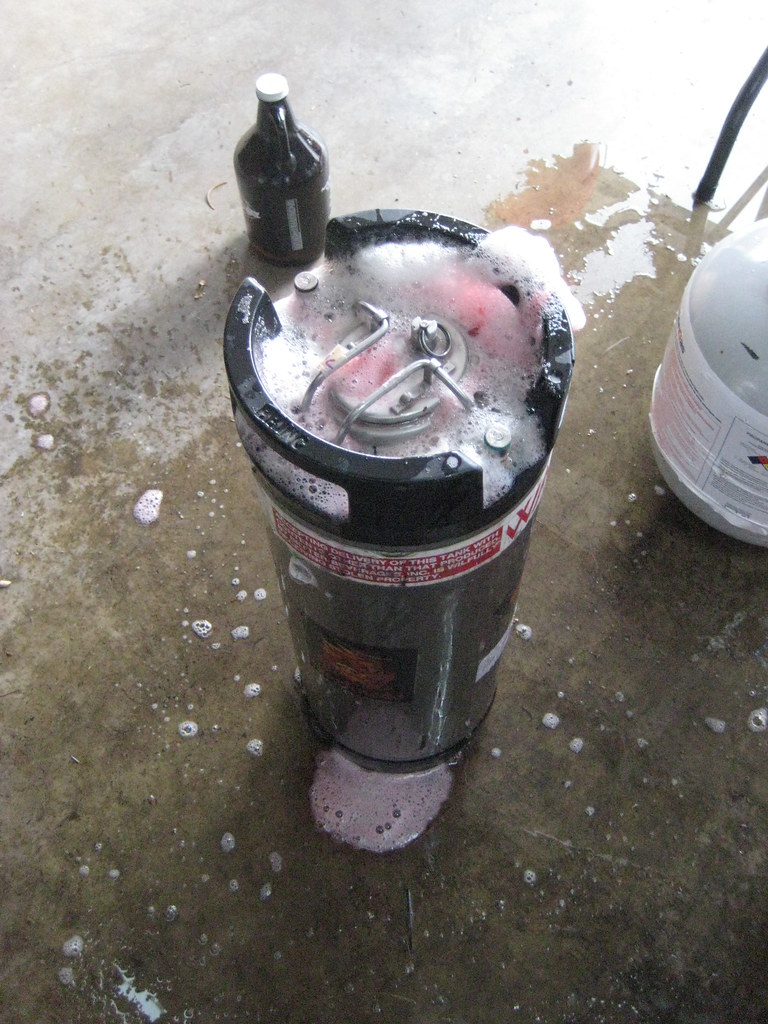
The pink foam
When I last checked it, it had turned very dark and almost muddy in clarity - a great departure from when I'd had it back in December while waxing Imperial Rhino Stout 2011. It was also very carbonated, despite not having been hooked up to a CO2 tank in months.  The flavor was completely different and while not bad, I think Daniel used the word interesting when he tasted it, it was missing something. One trick I've seen used here and there to add flavor dimensions to beer is to add fruit and give the yeast additional time to ferment.  I decided why not and asked my wife to pick up a bag of frozen fruit blend from the store.

Improvised blow-off
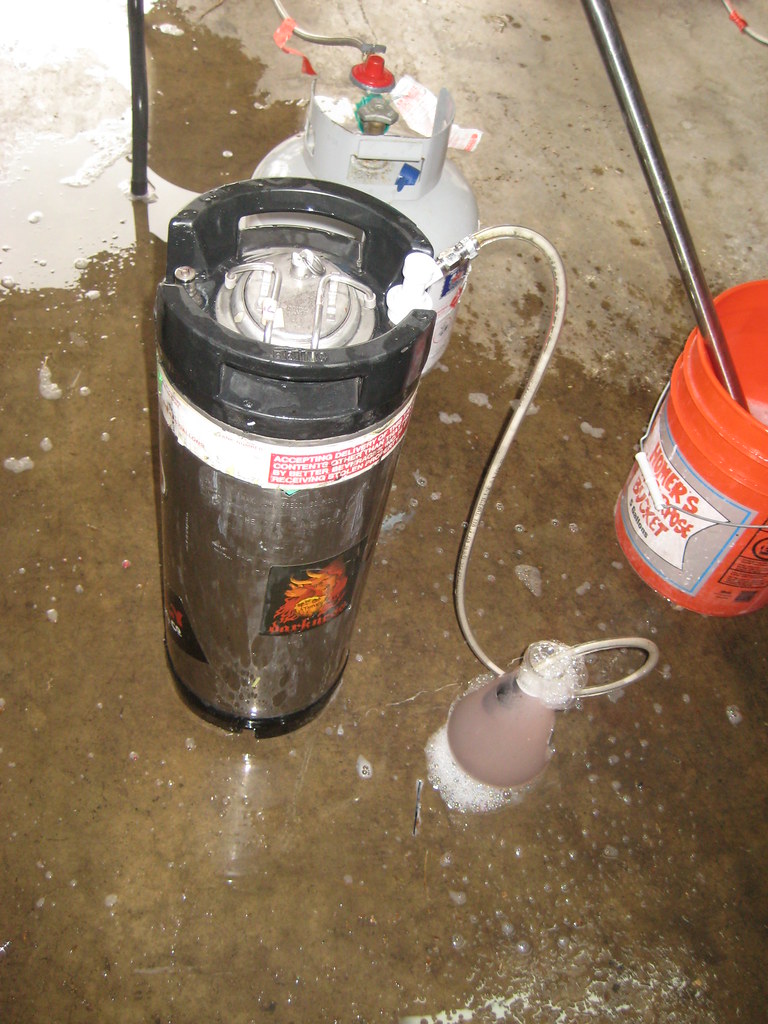
When I brewed the split batch porter I pulled out the frozen fruit and dropped it into some warm sanitizer. I then grabbed the keg of SNB can be CynicAle out of the cellar to cleaned and sanitize the top.  I also start the process of releasing the pressure from the keg.  Once it was ready opened the top to find a pretty sizable and fully head on the top.  I then dropped in the fruit... The fruit must have released some additional carbonation as about 3 seconds after I dropped it in the head turned pink and started rising out of the keg.  I quickly put the sanitized top back on and cleaned off the surface with some sanitizer.  Knowing that it would be fermenting for a while I fashioned a blow off tube out of a party tap attached to an air quick disconnect and a flask of sanitized water.   It was fun to watch it continue to degas while I continued on the porter.  I'll check in its progress in about a month or two to see it's worthy of representing SNB Brewing in public.

Cheers

-SNB

Tuesday, January 31, 2012

Westbennetteren 12

The main inspiration Westvleteren 12
Thanks Kevin (kbm)
I've been toying around with the idea of brewing a Belgian nah Trappist-style quad since I first tried Shawn's. It was a pretty eye opening experience for me.  I was still under an anti-Belgian-style beer kick due largely to my own lack of understanding of what it meant to be a Belgian-style beer and the wide scope that one label was being applied.  Shawn's quad was fantastic and made me long to try the ultimate examples of the the style Westvleteren 12.

That day came during my late night beer session for My Funky Brother Brett (which is tasting awesome right now).  We'd had a really good night of brewing and beer so on a whim I decide to open a bottle I'd been saving for several months to share with Rick and Daniel.   Few beers have lived fully up to the hype that surrounds them, this one did.

Daniel then became inspired to brew his own version for his 2012 Anarchy Ale called Westy Southwest.  He even made his own candi syrup for it which is really cool. I think Daniel taking the quad plunge was the last bit of inspiration I needed to just go for it and hop on the Quadwagon, Shawn had also recently rebrewed his quad.

The ingredients
The inspiration for the recipe came straight from the supplier of the candi syrup I used Candi Syrup Inc. I'd come across them while reading a post on The Mad Fermentationist.  They're a US producer of candi syrups that got into manufacturing them in part to nail a Westvleteren 12 clone.  They have a lot of great looking recipes on their site including one for Westvleteren 12.  Reviewing the recipe against Daniel's and others I'd found online made the decision to go with it as the basis a no brainer.  The only changes I made was to drop a pound of the D-180 and replace it with a pound of the D-90.  I did this after reading the second page of the recipe where they talk about the process of creating the recipe and mention using D-90 and D-180 together.  The other change was a minor hop swap.

Again the main issue was finding a time to brew it.  I've been training for a half marathon and have been doing my long runs on Sundays.  On Saturday I take my daughter to Little Gym mid-morning which places a damper on my brew schedule.  To make it even more complicated my wife was also training for a half marathon and ran the Tinker Bell Half the weekend I brewed.

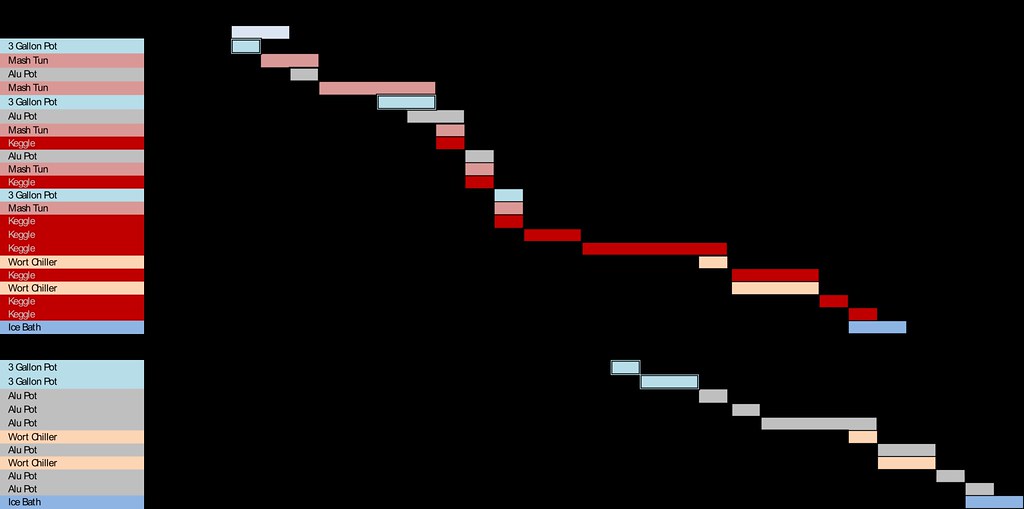
The solution I came up with was to use the mash time in my favor and brew on Saturday.  Having mapped out my brewday for the Double BIG IPL brewday back in December I knew when I would have to have the mashing going so I could take Syd to Little Gym.  From there it was a simple matter of working backwards.  

I borrowed some equipment from my buddy Marshall
to make brewing the second beer faster/easier
Par for my course as of late I was under OG despite taking a preboil gravity reading and using BeerSmith 2 to correct for temperature. I'm getting frustrated and might buy a temperature correcting refractometer. I'm following BeerSmith 2 instructions and have loaded my Keggle setup into for equipment. For the quad it wasn't the end of the world (-6 points) and nowhere near infuriating as the second running beer I'll talk about on Thursday.

I started the fermentation at 65 overnight and have been slowly ramping up towards the 80s.  I'll probably peak at 82 on Wednesday then start to lower back to 67F for 5 days before racking to secondary when the gravity hits 1.012.  Then it will be into the cellar at 50 for a couple of months.  Yes, I will be bottle conditioning this bad boy and plan on using Candi Syrup Inc's Simplicity to prime it with. I might even harvest some actual Westvleteren 12 bottle yeast for bottling.

Cheers

-SNB
Related Posts Plugin for WordPress, Blogger...