Pulled off of BA in light of the Great Banning of 2013
look: 4.5 | smell: 4 | taste: 4 | feel: 4.5 | overall: 4.5
Had on tap multiple times at the Costa Mesa location as well as pro brewers night at the AHA Conference.
This beer was the pro version of their Pro-Am competition for
A: Nice golden orange color with a frothy white head. Lacing remains well through the glass
S: Good hop aroma, I would have excepted more with it being related to an IPA but this is a Karl Strauss beer. I'm picking up Simcoe
T: More East coast then West coast and tasted more Ale then a lager but overall I it had a very nice flavor that I enjoyed greatly
M: Solid monthfeel with good carbonation.
O: A good representation of a non existent style. On of the best Karl Strauss beers I've had in years
Serving type: on-tap
07-12-2011 15:46:40

Showing posts with label Scott's BIG IPL. Show all posts
Showing posts with label Scott's BIG IPL. Show all posts
Monday, September 30, 2013


Thursday, February 21, 2013
Marshall's Matrimonial IPL
 |
| Marshall Mashing |
When one of my best friends asked if I would brew a beer for his wedding, I was immediately honored and of course said yes. I've know Marshall for almost 3 years ever since the first club meeting at AHP way back in 2010. We we both pretty early in our brewing careers looking to collect some feedback on some of our ordinarily beers. While I can't remember for the life of me what brought I'll never forget Marshall's. He called it Palate Wrecker and it was a big bastard of an IPA which he severed directly out of a 5 gallon keg keg he'd brought with him. I thought it was an outstanding beer and given my known affinity for hoppy beers it was clear early on we'd be a good match. It wasn't long before we started brewing a couple of beers together and enjoying even more.
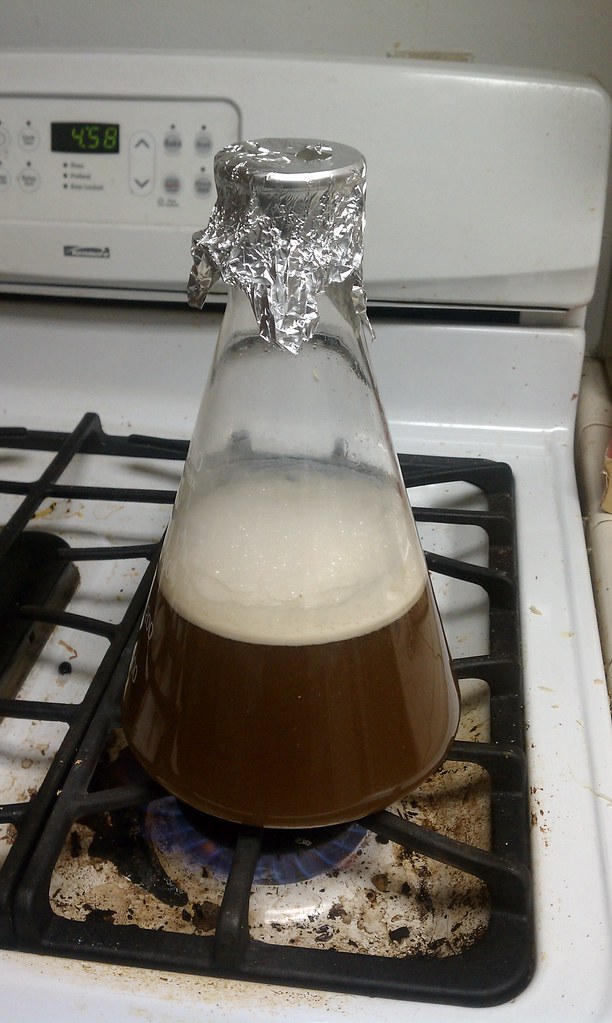
For his wedding Marshall requested a "clone" my most infamous beers - Scott's BIG IPL a beer I have so far produced 6 times now (7 if you count the one I did at Karl Strauss) so by now I've got it pretty much down. The major problem I ran into was a lack of lager yeasts at the shop, I guess turnover on them has been low and someone recently bought most of his stock. I therefore I to make a starter with Saflager 34/70, while not ideal was really my best option.
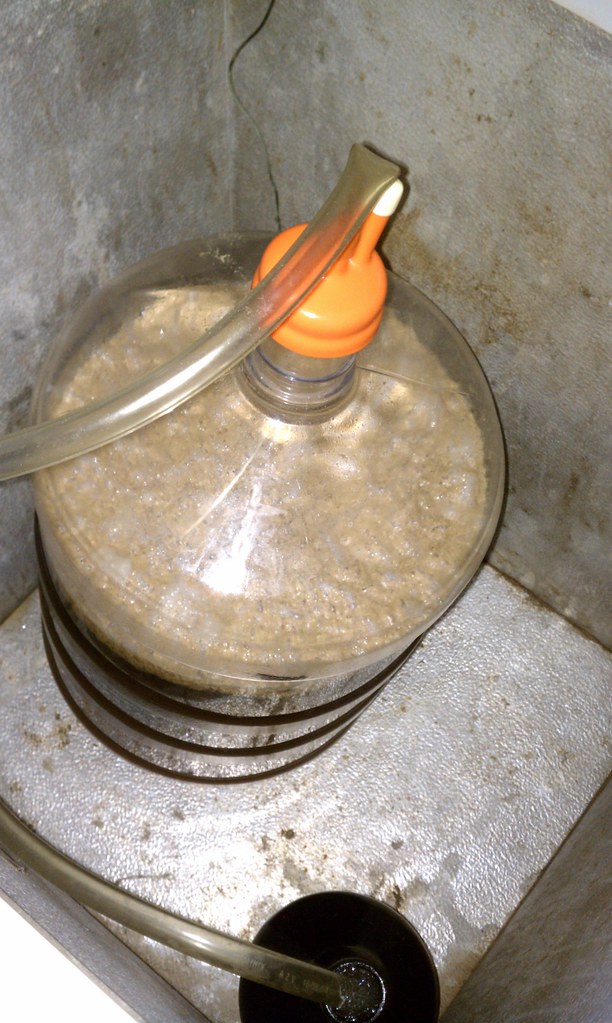 |
| Tucked in for the night |
At this point I've got working with Minute rice down pretty well. When getting ready to figure out my mash volumes and temps I remove the rice as well as about a half gallon of the strike water. To prep the rice I bring four quarts of water to a boil and add a pound of rice I then let it go for about 10-15 minutes while I finishing heating the strike water to temperature. Once all is said and done I add about after the strike water, the grain, the other half of the strike and finally the entire pot with the rice and water and stir it till everything is incorporated. I'm pretty sure I need to work a little more on the extract potential on of the rice as I think I'm not hitting gravity correctly because of it.
I had a couple of problems with the sparge, First was Marshall accidentally disconnecting the tube from the false bottom. It was pretty obvious as the first vorlauf was entirely grain. The other was a stuck sparge caused by compression around the false bottom, the root cause could either be double milling the grain (which I've done on every batch) or the rice. Or something else entirely.
Personally I think it's going to be a great batch and can't wait to try it in April.
Cheers
-SNB
Wednesday, June 20, 2012
Scott's GRANDE IPL
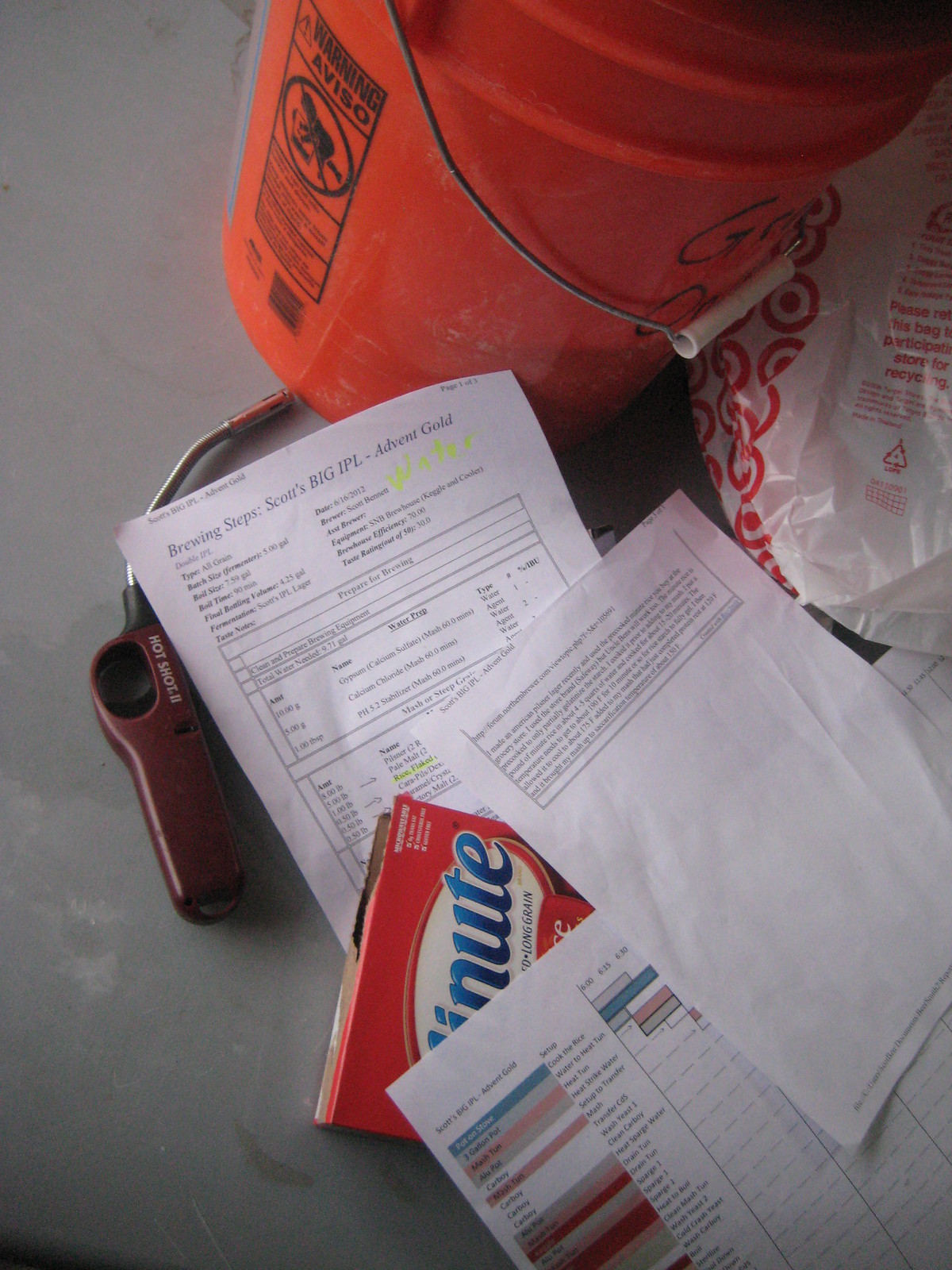 |
| Ready for another round |
As the title of my post indicates, for the latest addition of my BIG IPL series I decided to mix it up a little and add some Mexican flair in the form of one of my favorite lager yeasts WLP940 Mexican Lager. That's about the extent of the Mexican flair, no other ingredients just a new yeast which I harvested straight from the latest batch of Costa del Sol. (For the technique I employed for this check out Billy Brew's yeast washing video). The yeast was not the only change I decided to make; others included the amount of length of the boil, amount of knockout hops, the total bitterness and rice vs rice extract.
I decided to up the length of the boil from 75 minutes to a targeted 90. The reason I did this was a comment Robert Kennedy made at the AHP anniversary party about brewing with pilsner malt. He mentioned that if your grist has over 50% pilsner malt in it, then you should plan for a longer boil to combat the production of DMS. He therefore always boils beers with high percentages of pilsner malt for a minimum of 90 minutes. There seems to be a lot of conflict opinion online about the status of this belief/myth but I figured why not add a few more minutes to be on the safe side.
Another change I made was to do a little hop bursting at the end of the boil. Basically I kicked up the amount of knockout hops I planned on using from about 1 ounce total to 2. This should deepen the flavor and brighten the aroma at least that's the plan. I decided to do this after I have locked in the latest version of the recipe so it somewhat works against the next section of changes.
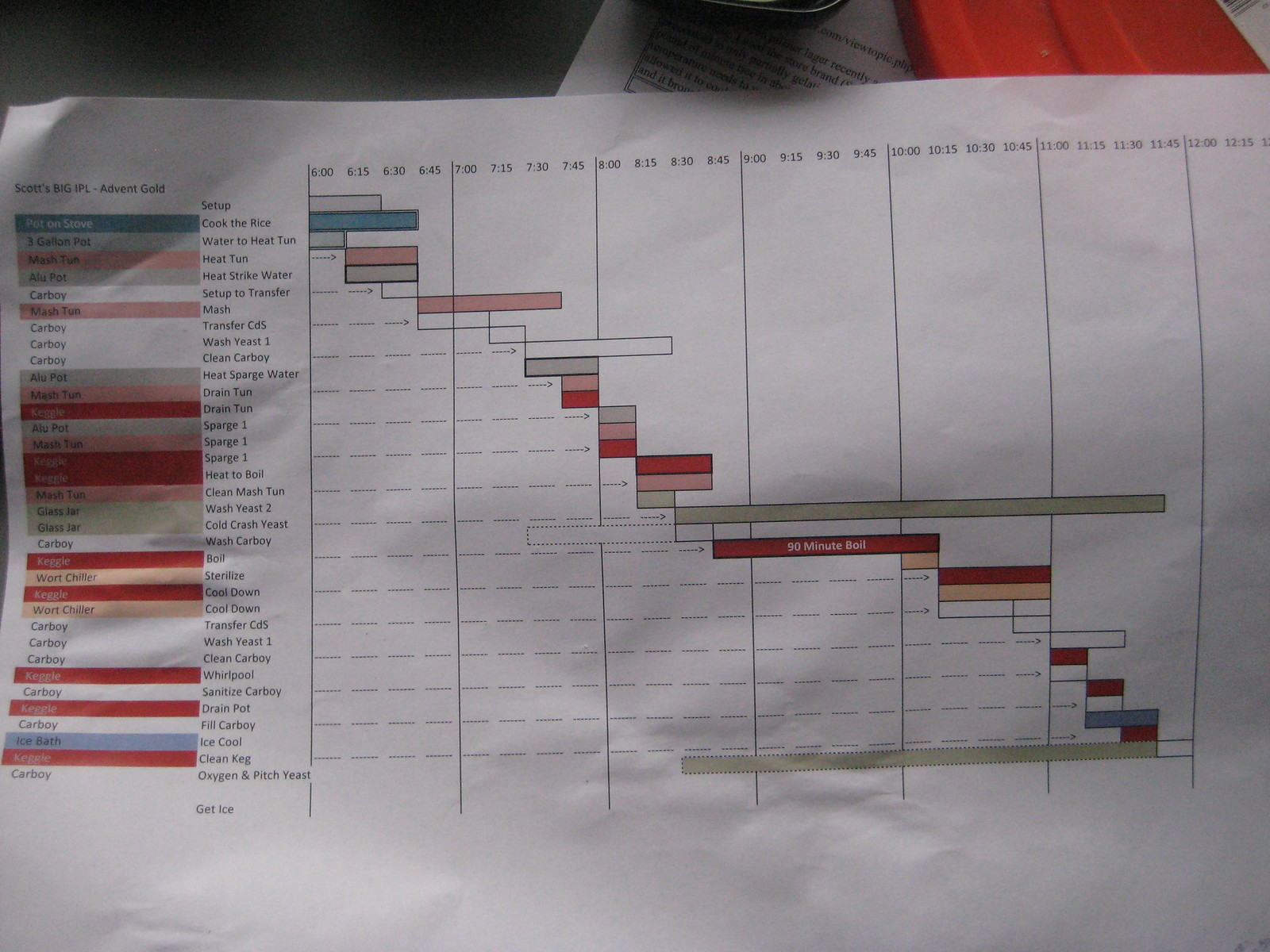 |
| Really trying to become more efficient during brewing |
When doing extract brewing topping off with additional water changes the hop utilization factor. When I was extract brewing I would routinely top off with about a gallon of water. I was doing this when I first created the recipe for IPL however in all my recipe sheets I had always built them for a full boil. When first I converted it to all grain I only worried about the grain not the hops keeping them around 100 IBU. I wasn't overly please with the final bitterness and flavor level with that first batch but assumed it had to do with the addition of the Citra, however when I brewed it again I still wasn't happy with it so I blended the extract and all grain versions together to round it out. I then went back to my notes and inputted the recipe exactly how I brewed it completely with a four gallon final volume topped off to five. Doing this I saw a 20 IBU drop to around 80 IBU which jived with both earlier recipes and the lab test Karl Strauss did on it. With this info in had I adjusted the recipe down to the 80s. In the end, the extra time (a lot more then 90 - read below) and the hop bursting bumped me into the 90s.
 |
| A little Westbennetteren 12 |
I decided that for this round I'd go all all-grain and ditch the rice extract. After a lot of researching I decided to use minute rice as it is precooked partially gelatinize. I cooked it prior to adding to my mash. I put a pound of minute rice in about 4 quarts of water and cooked for about 15 -20 minutes. I held the temperature at 190 for 10 minutes for rice starch to fully gel. I let it start to cool and added straight to my mash.
Using the rice complicated the brew a little as I had no tool to calculate the effect of adding over a gallon of 180ish rice to my existing grist. I also ran into the problem as my calculations had flaked rice in the main grist so all the water volumes had included that amount of matter in its water ratio section. To make matter worst I over shoot my strike water by 10 degrees, lowered it by 20 and figures the rice would bump it back to 148. Nope I ended up with a mash in temp of 142 so I pulled off a gallon of liquid, blasted it to a boil on the cooker and tossed it back in. I was able to then NAIL my mash temp at 148 for an hour while I racked the Costa del Sol to secondary and washed the yeast for later that day.
 |
| My favorite hop chart |
I failed to recognize until it was too late that I no longer had accurate water volumes and ended up over filling my preboil by over a gallon diluting my starting gravity by about 0.006 (1.051 vs 1.057). To try and catch back up I decided to further extend my boil to about 2 hours total. I was unworried about the additional time would do to the bitterness levels as the effect boil has on bitterness in non-liner, flatting out around 50 minutes. This meant only a change of a few IBUs total nothing to stress over.
I got everything ready and turned brewing operations over to my wife so I could take our daughter to Little Gym. As we were headed home Bonnie told me that we had run out of gas. I wasn't surprised as I had a feeling I'd run out (I should be tracking the consumption better). I told I'd be home soon and asked her run to Home Depot and switch out tanks. By the time I got home Brian Evans of Brain Evans Photography and Thee Beer Book had arrived to take some pictures. Brian had asked several months ago if he could come over and include me in Thee Beer Book project that he was working to finish up. I was quite honored as he's taken pictures of a lot of the guys I look up to in the OC brewing scene and I've known and followed his work for over a year now. We'd first met when he came over to photograph my friend Don Barnum during a brewday I had hosted at my house. It also happened to have been the day I brewed the Karl Strauss winning batch of Scott's BIG IPL, so it was fated that the day we were able to sync up schedules I'd happen to be brewing another batch.
 |
| Taking a picture of Brian taking pictures |
I took Brian around the brewery, covered some of the basics of what I was doing and showed him some of my favorite beers. I showed him how to transfer a beer to secondary which he had not yet had an opportunity to see and sampling the Coast of the Sun as it came out of primary. I'd saved my last can of 5/11 Furious for him to sample. We also sampled Westbennetteren 12, which I'd kegged temporarily until I get around to bottling, and thieved a sample of Halvtreds. Both are coming along wonderfully but I would like a little more sourness from the Halvtreds. Once Bonnie returned I brought the beer back to boil continuing the clock and showing Brian around.
Coming into the home stretch everything was looking good, I was progressing nicely on clean up, the photo session/demo hadn't majorly affected the process and according to my refractometer I had caught back up from my wort dilution earlier. Once the timer hit zero I killed the gas and started the chiller with all the new connections looking tight. At around 110 I opened the lid, explaining to Brian the importance of sanitation once the wort drops below 160, only to find a leak coming from on of the connections. Apparently the heat had soften the hose enough to allow a stream of water to escape. Refractometer and hydrometer readings conformed my fears as all the ground I had made up with the longer boil had been completely eroded giving me a corrected gravity of 1.073... boo!
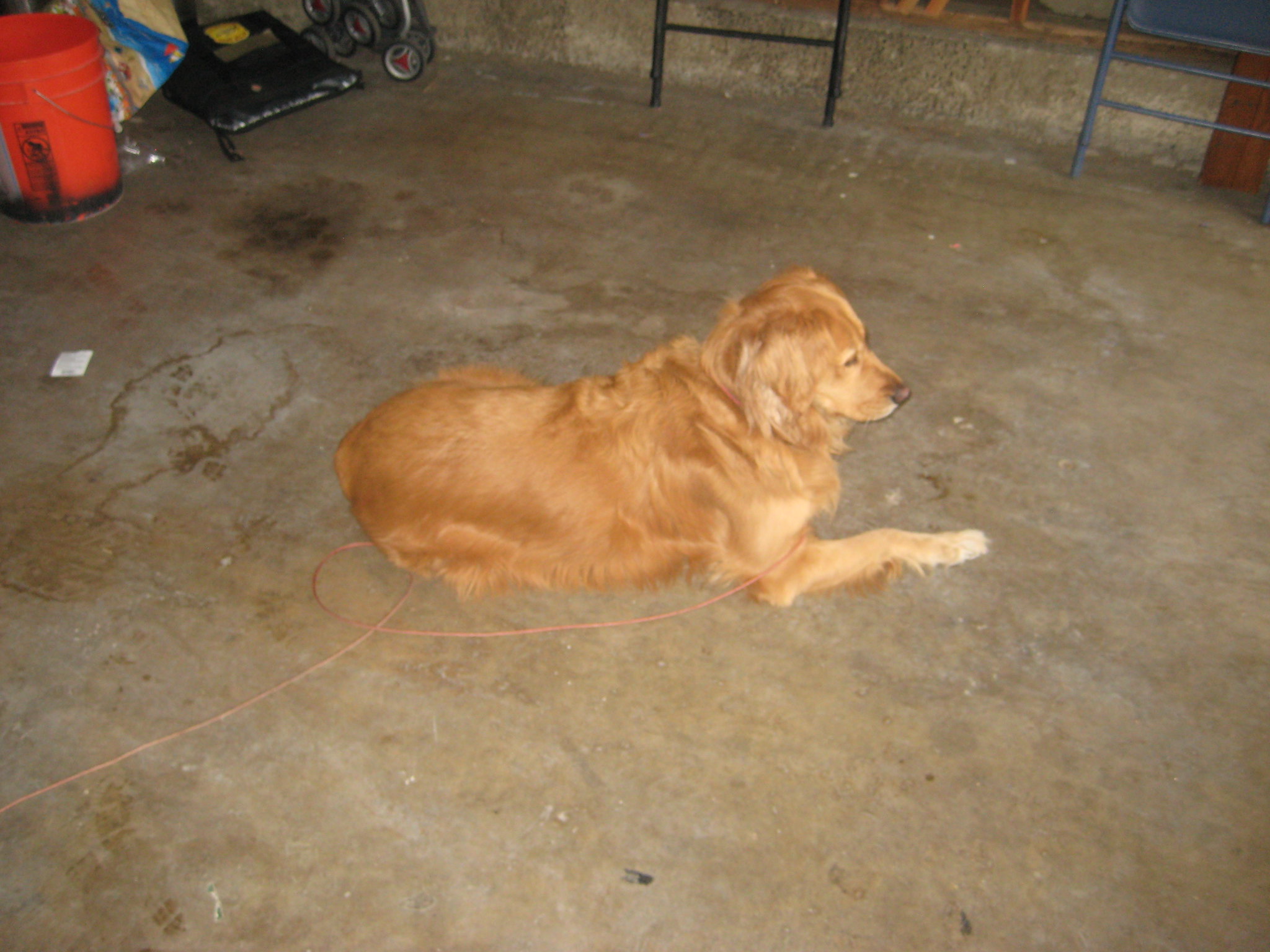 |
| Faithful dog companion |
Now I had a few options here; I could bring the wort back to a boil and attempt to boil off more liquid (the con side was that it would majorly mess with the bitterness levels and probably destroy the beer), I could bring it to 160 and hold it there for 15-30 minutes (this probably was the best option with time being the only issue) or I could do nothing and take my chances with the water (hoping that any contaminates present in the hose or wouldn't infect the beer). Going against my better judgement I opted with the third choice and fixed the leak and continued the cool down. I figured I had a pretty healthy yeast cell count tailor made for the cold lager environment it would be exposed to. Basically I was gambling that the nutrients, cell count and environment would make the yeast the dominate organism the beer not outside contaminates.
Figures crossed
-SNB
Tuesday, March 13, 2012
Stone's 2012 March Madness Homebrew Competition & AHA Rally
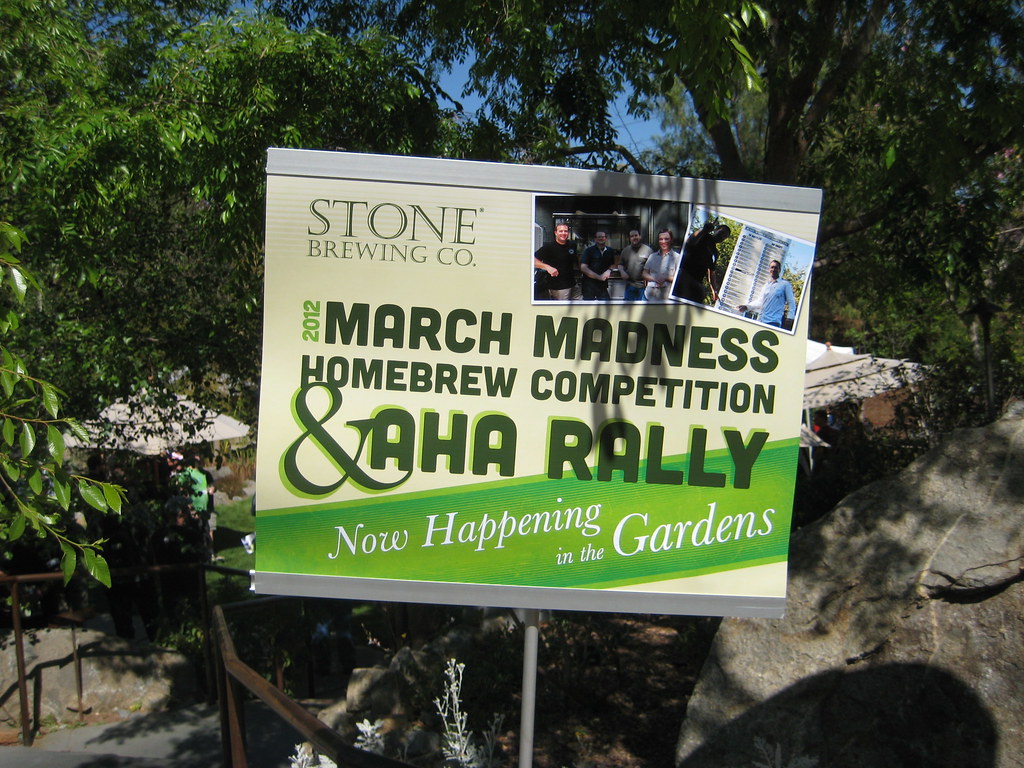 |
| Welcome Sign |
This past Saturday I competed in Stone's 2012 March Madness Homebrew Competition & AHA Rally with my Scott's BIG IPL. This was the second time in a row that I took part in the competition and the first time I really planned for it. Last year I found out about it mid-February and with only a month till the competition I had nothing put together for it so I decided to brew my Hopped Up Hef (my photos from last year). This year I knew I wanted to do it again and really wanted to enter the Scott's BIG IPL. This rally/competition was the reason I brewed Scott's BIG IPL both Alchemy Guild (All Grain) and Excelsior (Extract) back in December, so that I would have a complete 10 week cycle to get it ready. Honestly I think the BIG IPLs could have benefited from another couple of weeks of lagering and it seems to be that they moved the rally up a week this year, but in the end I had no choice and got ready to go.
Gearing up for the event I looked at which of the two versions I wanted to enter. For some reason neither seemed to be 100% what I was looking for and neither seemed to clear. This represented the first time I was unable to brew a crystal clear lager. During my tastings I mixed samples and found the mixture of the two to be greater then the sum of it's components. This phenomena was seconded by my wife, Daniel and Marshall in taste tastes. I therefore decided to blend them 50/50 at kegging. Once I had them blended I decided to try and use gelatin to clear the competition keg of beer. Even though I followed the directions to a t it failed to clear after a week. Fortunately the gelatin had the same effect on the taste as it did the clarity (the reason I only did it to one keg) so I was set.
 |
| An Impressive list of Beers |
Daniel had volunteered at the rally and even though they never contacted him he still volunteered to give me and my set up a ride down in his Prius. We got down there around 11:20 and I was surprised to find everything pretty much set up and only one other jockey box. Last year 90% of the draft beer came out of jockey boxed this year, only 2 with everyone else using cobra taps.
In total there were 40 entries, 22 bottles and 18 draft. As a sign of my early entry this year I was number 23, the first of the draft beers (the year before I had been 38). To take part in the competition, as both a competitor and a consumer, you have to be a standing member of the AHA (American Homebrewers Association). The event is free to AHA members and you can register or renew at the door. The basic set up of the competition is simple, all 400 AHA members in attendance (they actually had to close the event online this year do to capacity constraints) are given a ballot with 3 spots to vote for their 1st, 2nd and 3rd favorite beer. The votes are then tallied and the 5 top vote getting beers advance to a final tasting panel made up Stone personnel. Stone then announces 4th-1st with the winning beer becoming the next Stone Collaboration.
 |
| Pirate's Breakfast from Chism Brewing Voyage |
Of the 40 beers available (I didn't try them all) some of my favorites were, Pirate's Breakfast (8.0 Imperial Breakfast Stout made by Curtis over at Chism Brewing Voyage who I got a chance to meet and hangout with), PP Steeze Imperial Coffee Vanilla Porter (10.5% Oak-aged Stout) and Mango Habenero IPA (by far one of the best aromas I've ever smelled on a beer - super mango goodness). Mint beers seemed to be a theme this year as four were present, the best of which was Ken Schmidt's Pillow Mint at the Ritz (Ken won the first Stone Homebrew Competition and would go one to win this one with this beer). The other theme seemed to be bad beers as Daniel went through a particularly bad streak dumping over half the beers he tried, the worst of which was a beer called Lactic Lupulin which was a "dry hopped sour mash ale." I'm using quotes it as it was questionable whether it was a beer at all. Not only was it a drain pour but it stained our glasses with it's sink requiring a very strong stout to get it back.
One interesting interaction occurred that day when I suggested to one gentlemen that he try #23. He scoffed and remarked that he was "pretty sure it was the same guy that won the Karl Strauss competition the year before" as if that alone was a reason not to try it. I then told him that I had first hand knowledge that it did indeed win the Karl Strauss competition as I had brewed both. I explained a few of the challenges that went into brewing the Strauss batch and insisted and if he had tried that version (Karl's) he owed it to himself to try my version there. Pretty funny if you ask me.
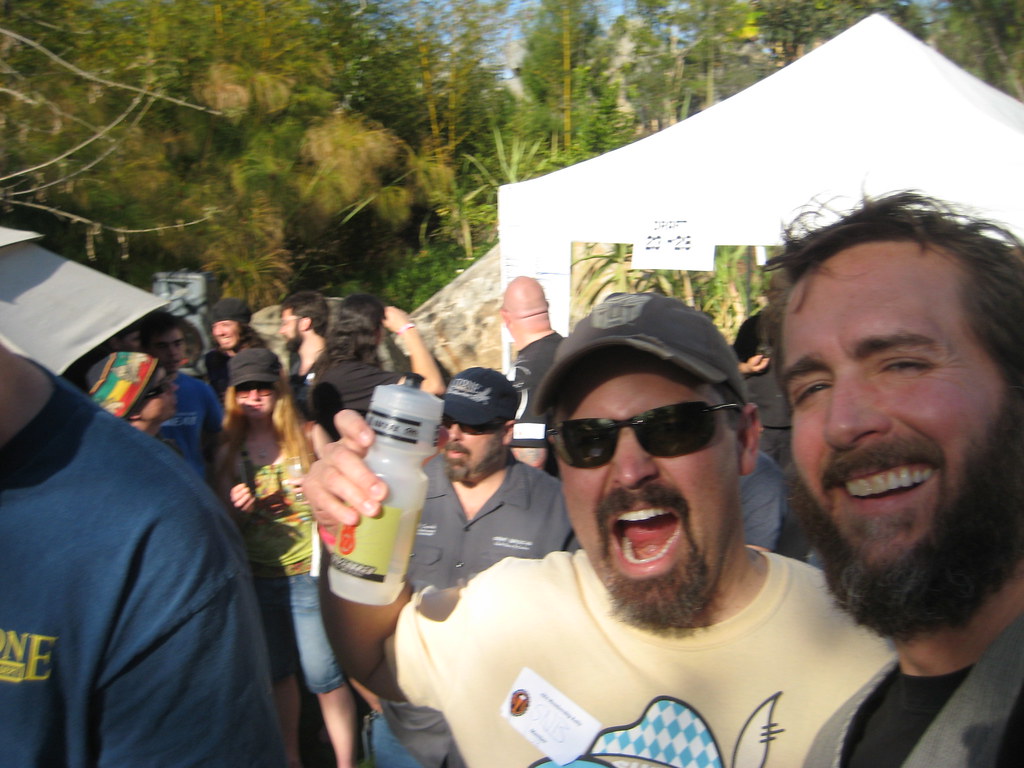 |
| Yes, I am doing my "Greg Face" |
As much as I really wanted to win or at least place, I had deep doubts if I'd see anything. It wasn't the best batch of BIG IPL I'd done both in clarity and taste. So as we waited I really didn't think I'd hear my beer mentioned. Turns out I was wrong as the first beer that Mitch Steele announced was "number 23, Scott's BIG IPL a Double India Pale Lager". This placed me in forth. Stoked, I made my way to the front and onto a bolder to shake hands with both Greg Koch and Mitch Steele while posing for photos. I even had Greg snap one of his famous self shots of us with my camera. I also scored a certificate for dinner for two at the Stone World Bistro and Gardens, which is pretty damn awesome. Rounding out the top 4 were the PP Steeze Imperial Coffee Vanilla Porter in 3rd, Mango Habenero IPA in 2nd with Ken Schmidt's Pillow Mint at the Ritz winning the day.
After the lack luster Scott's BIG IPL w/Citra and the clarity and flavor issues I'm detecting with the latest batches, I was having a lot of doubts about my ability to recapture the magic that was my second batch of Scott's BIG IPL. So while I didn't win, placing 4th is a competition with some seriously good beers really lifted my spirits prepping me to go back to the lab and make the next batch of Scott's BIG IPL the best one yet.
As for next year, at this point I don't know what I'll enter. It could be another batch of Scott's BIG IPL (under a different name), a monster Triple IPL I have floating in my head or even a big stout. At this point I don't know the only thing I do know is I'll be back.
Cheers
-SNB
Friday, February 10, 2012
Brewing Beers with Big Hop Aroma
 |
| One of my favorite charts illustrating the various hop additions |
One of my favorite things about a good IPA is the burst of citrus/pine aroma I get when I take a deep sniff. In brewing there are several time periods to add hops to the boil, each having it's own function. The classics are Bittering (over 60 minutes), Flavor (20-30 minutes), Aroma (0-5 minutes) and the mother of all aroma Dry Hopping.
Dry hopping is generally done in secondary fermentation and there is some logic behind this. The first bit is that active fermentation can be quite aggressive and literally eject a lot of the hop aroma out the airlock. The next bit has to do with maximizing the surface area of the hops exposed to the beer by eliminating anything that is not beer ie the left over yeast.
 |
| In line shot of dry hopping |
When it comes to dry hopping lengths opinions very depending on who you ask as it's a topic that is up for debate. Generally for warm fermented beers I prefer to keep the length of dry hopping to 1-2 weeks and for cold fermented beers a little longer 3-4 weeks. This is how I actually come up with the BIG IPL dry hopping scale. I was following the BIG IPA recipe and had dry hopped in secondary. The beer was a long way from being completed and I was nervous that if I left it on the dry hops for too long it would pick up some grassy flavor. I therefore decided to move it to a tertiary vessel with additional dry hops using hops I just happened to have left over from it's brewday.
Moving beer from one dry hop to the next is not so unique, for instance when Mike over at the Mad Fermentationist posted the recipe for his version of Pliny the Younger he included the dry hop schedule straight from Vinnie Cilurzo himself. Vinnie strongly believes in getting his hoppy beers off of the dry hops as soon as they have fulfilled their purpose and for Younger he dry hops a total for 4 times post primary.
DH 1 Simcoe, Amarillo, Centennial for one week and remove
DH 2 Amarillo, Centennial for one week and remove
DH 3 Simcoe for one week and remove
DH 4 Simcoe, Amarillo Dry Hop in Keg
 |
| The Ultimate Hop Chart by Zeke Shore Buy it at Hopschart.com |
When adding dry hops I prefer to put them in first and rack the beer on top of the hops. I have done it both ways and been please with both results. I've have occasionally been known to forget to add hops during the initial transfer and add them later. When brewing Costa del Sol I move the beer to secondary clean and only dry hop a week or two before I keg.
When selecting dry hops I look to the aroma descriptors via Hop Union or other online sources. I will admit that I was much more experimental when I first started brewing and played around with a lot of different hops. These days I know what I like and have really narrowed my hop varieties down to a handful, especially when it comes to dry hopping. My favorite hops to dry hop with are all pretty classic dry hopping hops. Amarillo (apricots and peaches), Cascade (floral and citrus), Centennial (fruity), Columbus (dank, onion, garlic, spice), Citra (passion fruit, grapefruit) and Simcoe (pine). I think Amarillo and Simcoe make an outstanding pair not only in dry hopping but throughout the process. Citra is another excellent aroma hop that goes great in IPA, I've not had luck in pairing it with Simcoe but it's a good partner for Cascade, Centennial, Columbus and Summit.
One thing to look at when brewing a big hoppy beer is the Cohumulone (one of the two primary alpha acids in hops). Low Cohumulone levels in a hop leads to a more smooth bittering.
I'll reiterate something I mentioned in a previous post on secondary and tertiary
transfers. Prior to transferring I flush the carboy with CO2 from my keezer
prior to filling it. This is especially important when it comes to hoppy beers as the CO2 flush reduces oxidation preserving a fresher hop character.
Cheers
-SNB
Thursday, January 5, 2012
Scott's BIG IPL - Excelsior aka Bonnie's First Brew
 |
| Taking her First Hydrometer Reading |
I mentioned in my last post that I had pulled a double brewday over my vacation brewing up two 5 gallon batches of Scott's BIG IPL two ways; Alchemy Guild (All Grain) and Excelsior (Extract). This is the story of Excelsior.
After my slight disappointment Scott's BIG IPL w/Citra I decided I needed to go back to basics and brew a control extract version to compare the all grain version against. This was a simple matter of going back through my notes in BeerSmith to identify the correct version. I was actually amazed at how little Amarillo was in it given the fact I had just bought a pound of it thinking it was a key ingredient up there with Simcoe.
The biggest surprise to be came when my wife Bonnie told me that she wanted to brew up the extract version. It was a big help and relief to me as I didn't have to run back and forth between the garage where the all grain version was going and the kitchen where we steep the grains for the extract version.
Oh how I've missed the speed and efficiency of a extract batch. Not only was it done in half the time but it nailed it's gravity, something that has driven me nuts over the last several all grains. It also pared really well as the second half as I was able to utilize my old equipment and the kitchen to get it going.
Bonnie had a blast and wants to be even more involved (I had brought it to a boil and watched it) and do her own beer. She just has to decide what she want it to be.
The next time I brew a BIG IPL will be in mid-February for the 2012 SCHF. I haven't quite decided how I will serve it (beer engine, over mangos etc) but we have several months to decide.
Cheers
-SNB
Tuesday, January 3, 2012
Scott's BIG IPL - Alchemy Guild
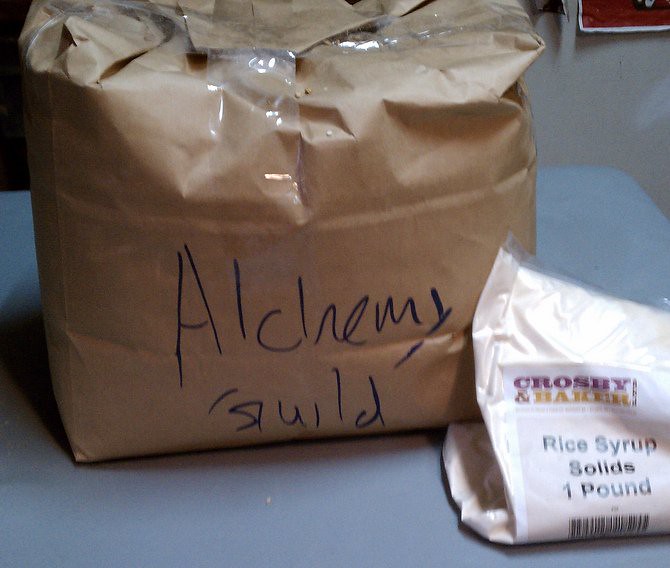 |
| The grains |
After Christmas I took a few days off to hang out around the house and catch up on some projects. One of the things I really wanted to do was spend a couple of days brewing, including a double brew day where I brewed up two recipes of Scott's BIG IPL.
The first of the IPLs I codenamed Alchemy Guild. Alchemy Guild revisited the All Grain malt bill that I had come up with for Scott's BIG IPL w/Citra and returned to the hop bill of the original 2 versions. I did this because I was somewhat let down by the way the Simcoe and Citra seemed to interact in the last batch. I also dropped my efficiency down to 60% in hopes of nailing my targeted 1.078 gravity.
 |
| The IPL Double Brewday Schedule |
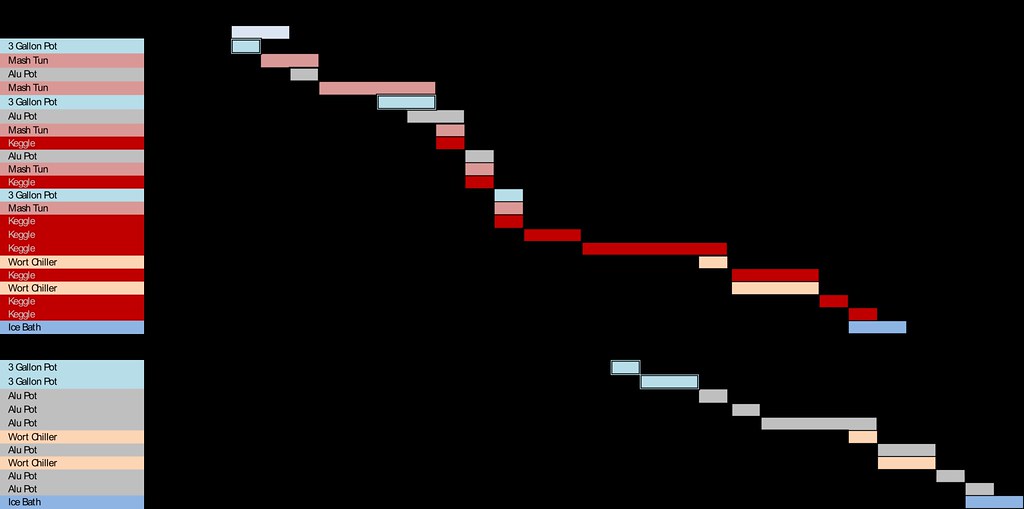
I had to get a pretty early start on it as I was doing two batches back to back and I wanted to be done around lunch time. To keep myself on track I created a gantt chart in excel outlining all the major steps and time I estimated each step would take. The was to determine when specific pieces of equipment would be free primary the main burner. From there it was a simple manor of working backwards for the other IPL, which I'll go into more detail on Thursday.
For the most part the schedule went really well, there were I few items that I had failed to take into account but I was able to make up the time at later steps (mostly by combining my batch sparges).
Almost par for the course with me and All Grain I came up a little under my gravity (1.073) which is getting pretty frustrating. I need to spend some time really studying how people are mashing as well as take a look at some other factors I think are at play. I'm going to stick with batch sparging as I've read it helps cut down time and most only experience a few additional points of efficiency yet an hour or two more time commitment.
Cheers
-SNB
Tuesday, December 6, 2011
BeerGunning the Imperial Rhino Stout 2011
Back in 2010 I made a big holiday beer out of some left over
ingredients. This was before I was doing
starters, multiple early O2 infusions and yeast rousing. It ended up being a pretty high alcohol beer
at around 10.17% even if it was pretty sweet with a 1.026 FG. I bottled it up in champagne style 750 ml
bottles with some carb tabs. In
retrospect I should have added some fresh yeast as after several months most opened
bottles were flat.
 |
| One of my favorite pieces of brewing equipment |
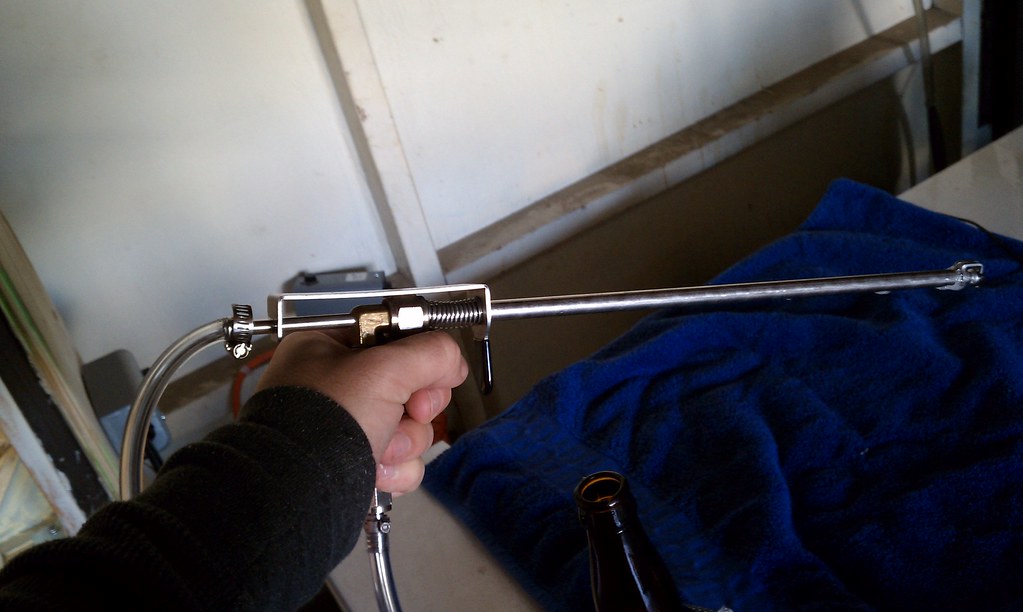
It should be obvious why bottling from a BeerGun is so
great. Basically it allows you to really
dial in the carbonation level you want in the beer, eliminates concerns on
carbonating high alcohol beers and there is no bottle sediment to cloud up my
beer once poured. I’m sure several
people with disagree with eliminating all bottle conditioning potential of the
beer but for the most part I’m not brewing the types of beers that benefit from
bottle conditioning.
I busted out
the BeerGun both Saturday and Sunday this past weekend to fill some
bottles. The Saturday I only filled 8
bottles total; 4x 22oz Scott’s
BIG IPL w/Citra to take to various events, 2x 12oz Scott’s BIG IPL w/Citra
for the 2012 Doug King
Memorial HomebrewContest next month and 2x 12oz StarRaptor
to send to my collaboration partner.
 |
| The newest label for Scott's BIG IPL |
Sunday was
much different as I set out to drain a couple of kegs. First up was the bottling of all remaining Imperial
Rhino Stout 2011 into 12oz bottles.
Later this week I’ll label and wax them.
After that I filled a case of 22oz of Marshall’s bourbon barrel barley
wine so I could get back the keg I’d lent him.
The BeerGun is a great tool for any homebrewer to have in
their toolbox. It assembles and disassembles
quickly for easy cleaning and works exactly as advertised. It has two triggers, one flushes the bottle
with CO2 to protect the beer from oxidation and the other fills the bottle with
carbonated beer. Once you flush and fill
a quick sanitized crown goes on as usual. The trick I’ve found to filling bottles with a
BeerGun is to have the bottle and beer at
roughly the same temperature. You can
chill the bottles two ways depending on time, in the fridge or if you’re in a
pinch the freezer. If I’m pressed I
clean and sanitize the bottles then stick them in the freezer while I set up
the bottling table.
I'll be back on Thursday to cover labeling and waxing the Imperial Rhino Stout 2011
I'll be back on Thursday to cover labeling and waxing the Imperial Rhino Stout 2011
Cheers
-SNB
Tuesday, November 29, 2011
Halvtreds - Soured Red Lager
 |
| Halvtreds aka Batch 50 |
The day after Thanksgiving I set up my system early in the morning (6:30) and set to working brewing my 50th beer. It was coded named Batch 50 for so long that when it came time to write this post I knew it by nothing else so in a last ditch effort to not call it Batch 50 I translated fifty into Danish and got the name Halvtreds. I think Halvtreds is a pretty suiting name for a red colored beer.
When I set out to craft a recipe for my 50th batch of beer I had a few critria for myself:
- It should have the ability to be aged
- It could be an ale or a lager but should be brewed with the house yeast (WLP007 for Ales and WLP840 for Lagers)
- The hops used should be northwest hops
- It should include ingredients that are indicative to me
 |
| I made a 3 pint starter with some amber DME |
I decided along the way that Halvtreds should be a mile stone in another way and decided to make it my first full on sour beer. I've been playing with funk in BeanyTink Farmstead Ale, SNB can be CynicAle and DG' Peach Farm but had yet to venture into anything over the top sour.
Venturing back to my list of criterion here's how Halvtreds fits the bill.
- A 6.8 sour will not only take over a year to develop but should last well beyond
- I decided to make it a lager and pitched a lager starter made with second pitch of WLP840
- Cascade for the bittering plus some Citra and Cascade for flavor with an ounce of Columbus at knockout.
- It's a partial mash that incorporated some of my favorite malts (Victory and Carared) and a lb of Rice extract a la Scott's BIG IPL. The grain bill itself is almost identical by percentages to StarRaptor
A few things I learned while researching sours that I figure I would pass on; 1) IBUs are keep light for a reason, too much above 20 IBUs will hamper the bugs as hops are a preservative. 2) Some styles of sours are initially brewed clean then soured with bugs after primary while others are given an overnight souring mash at 120 degrees. For Halvtreds I kept the IBUs minimal (20.5) and scheduled a clean lager fermentation.
 |
| Transferring to the fermentor |
For the bugs I'm going to try to get my hands one of the sour strains from East Coast Yeast. I missed the last round while out shopping over the weekend but with a month or more of clean fermentation I have time to try again. Worst case I'll pitch a White Labs sour blend with some bottle dregs.
Brewday itself was pretty smooth, I had to go into work at 4:00 AM then hit up some Black Friday sales so I was able to get an early start.
I mashed high at 156 because I wanted to give the bugs some extra food to chew on. I initially missed my mash temperature so I drained some of the liquid and heated it up in a small pot allowing me to nail the 156 temp I was looking for. I'd been trying to shorten my mash time to 20-30 minutes but for this round I set it initially at 40 so I could keg up Scott's BIG IPL w/ Citra. It took me a little longer and by the time I heated my sparge water the mash ended up being around 55 minutes. Oh well next time.
Cheers
-SNB
Friday, September 30, 2011
In Progress Tasting
Marshall and I were talking the other day about how if we ever open a brewery we’d probably end up drinking 3/5th of it before it’s finished. We say this because we find that we're constantly tasting our beers throughout the brewing process. I can't fully speak for Marshall but generally I do this to check how the beer is progressing. While I rarely make mid fermentation changes but it does give me the ability to do so, for instances I can always add coco nibs or oak (both plain and spirit soaked).
Here’s a rundown of every phase of fermentation that I taste the beer.
The first place I do any tasting is actually while shopping for ingredients. If I’ve never used a current type of grain before I general eat a couple of the kernels to get a general sense of the flavor profile it can add. This method is actually how I started to employ both victory and carared.
Next up is while sparging, I’ll taste a little dab of the wort while I'm getting ready for my iodine test (no I don’t taste the iodined sample). Here I’m looking to see if it has a sweet taste to indicate starch conversion has occurred.
Next comes after the boil is completed and the wort is cooled, I drink the hydrometer sample. This is more tradition than anything else. At this point I have drank the hydrometer sample of every beer I’ve ever brewed (including the Karl Strauss batch). This is not a good gauge of the finished product as some of my smoothest and sweetest beers, such as my citra wheat series, have tasted 180 degrees different then they did at the hydrometer sample.
 |
| Checking the color, clarity and taste on StarRaptor |
After that I sample whenever I take gravity and during transfer to secondary (or tertiary). This is a great opportunity for me to check color and clarity as well as getting a since how it’s coming taste wise.
For some of my bigger beers (such as Imperial Rhino Stout2011) or a funky beer (such as SNB can be CynicAle) I pull or thief samples purely to check the progress of the beer. These types of beers generally have a pretty long conditioning cycle for the taste to end up where I want it. The last thing I want to do is start serving a beer too soon.
Generally I'll have another sample while I’m kegging it up and then several while I’m carbonating it to check the level of carbonation.
Here's some notes I made over the weekend when I sampled three of my beers in progress.
StarRaptor: Brilliant clarity and I’m loving the color, it’s a little darker than I was targeting but man it’s a nice garnet shade of red. Still pretty fusel/hot (large alcohol presence) but it is mellowed out since the last time I had it.
SNB can be CynicAle: Tasted during transfer to secondary. Great straw color and the flavor is right around where I want it. It’s shaping up to be a pretty interesting combo, very much an amalgamation of Cynic and BeanyTink.
Scott’s BIG IPL w/Citra: 1 week in hydrometer check sample. The corrected hydrometer sample shows that it is currently sitting at 1.020 SG, not bad for a one week old double lager. The taste is very bready but it has a nice nose and some good hop flavors. Diacetyl rest started Wednesday morning and will last till I transfer to secondary and dry hop this weekend.
I hope you enjoyed this brief glimpse into my tasting insanity
Cheers
SNB
Monday, September 26, 2011
Scott's BIG IPL w/Citra
Well here it is, for the first time ever in one place, the full recipe and story behind Scott's BIG IPL. Well, sort of anyway...
I've brewed this beer three times now (four if you count my brewday with Karl Strauss), each time I do there is a slight change here and there to the recipe.
 |
| Recipe sheet |
The first time I brewed it was for a demo at Addison Homebrew Provisions. It was an adaption of my Scott's BIG IPA recipe that had recently won the store's competition. The main hop bill was the same but the malt bill was modified greatly to play off the lager aspect adding plisner DME and rice DME. I was inspired to brew this beer after having a pint of Humulus Lager at the Bruery several weeks prior to the demo. Not only was this beer my inspiration of doing a lager IPA but is also the origin of the rice addition.
When it came time for the demo I got distracted and combined a couple of additions and missed a time here and there, but this is the reason you should always notes and I wrote down and tracked all these modifications. This is also the reason that only people who were at the demo and tracked these changes would have the recipe to that point.
Final changes to batch one against the recipe came with a second dry hopping into tertiary. There is a lot of good information out there when to how long to keep hops on a beer and because this is a lager it takes longer and I grew concerned that I would start to get off flavors so I decided to move it a tertiary with even more hops.
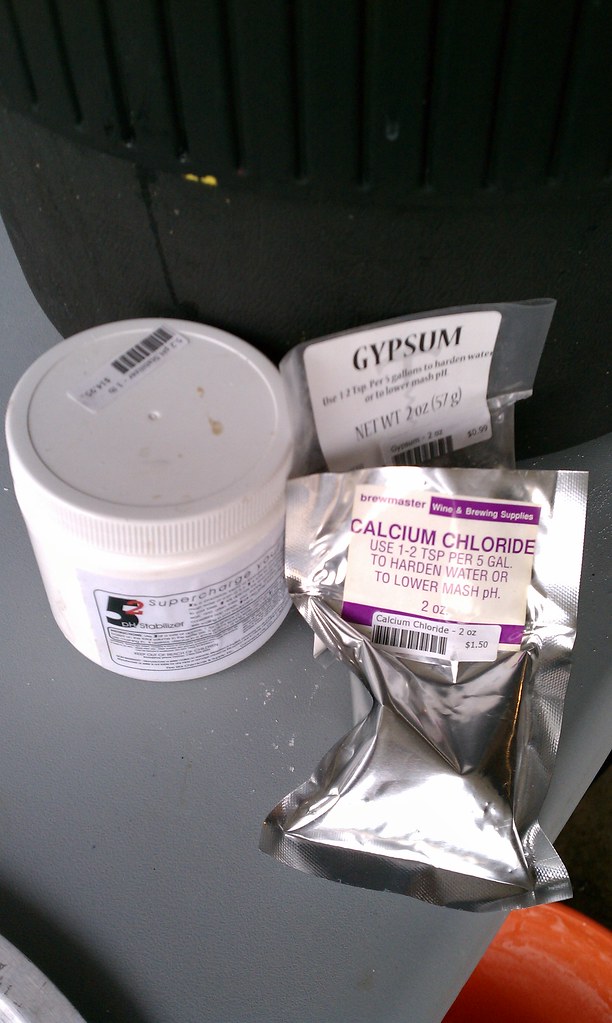 |
| Some of the water agents used |
Batch 2
With an empty keg on my hand and a cool winter in place I decided in January of 2011 it was time to brew it again. I went back and forth with whether I would brew this beer a my next brewing demo in mid January or do it at a club brewday the week prior. In the end I opted to do it at the brewday and do up a batch of Smoked Pepper Porter at the demo to be served at the club booth at the SCHF 2011.
I went back to my notes and review my posts on the forum to create batch 2 of the recipe.
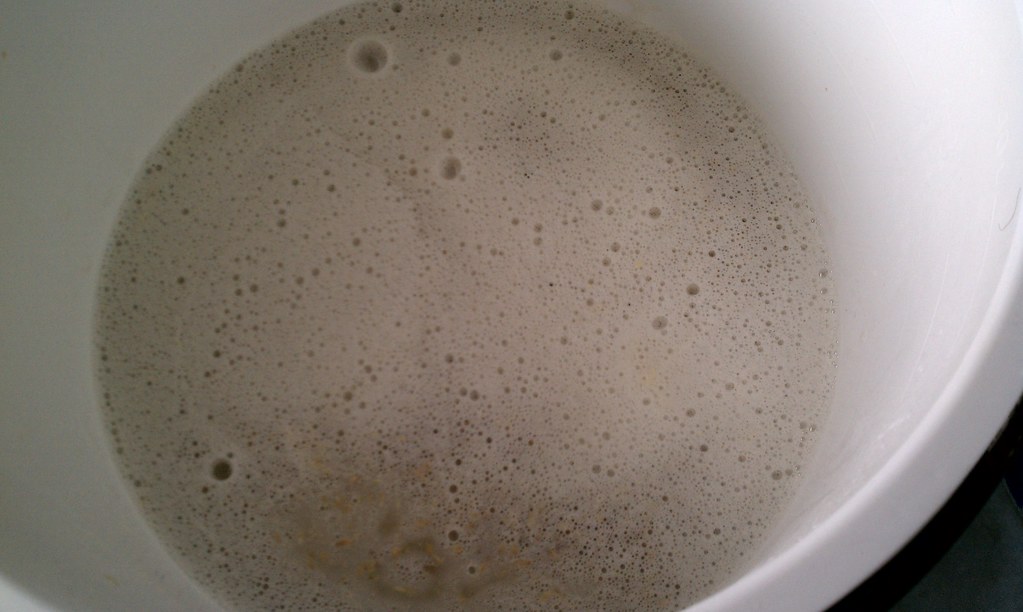 |
| The mash |
It was early on in the fermentation cycle that I noticed a post on facebook about Karl Strauss holding a contest where the winner would get a chance to brew their beer that the main brewery and have it entered in the Pro-Am competition at the NHC 2011 in San Diego. Having been a fan of Karl Strauss in the past I decided I wanted to enter, the question was what. I knew I had enough time to to an IPA but sorta wanted to enter the still fermenting IPL. As fun as lagers are and how good the results are they're not the type of beer one can rush. Still I thought it would be a good beer to enter but would it be done in time.
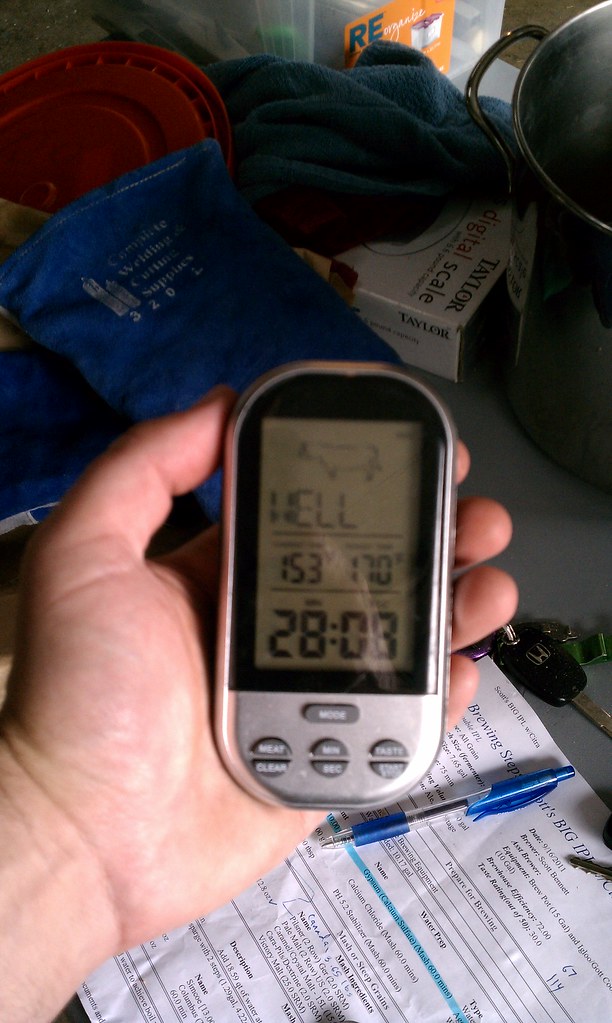 |
| 153 for 1 hour |
As some know I did enter it and ended up winning it.
Batch 2ish the Karl Strauss Version
I guess I ended up brewing it again between Batch 2 and the latest Batch 3 with Karl Strauss, however this was not my recipe but rather their take on it.
I'm not going to go into much detail on it, but if you are interested you can review the full story on the AHP forum here and here.
I will say this, in retrospect I have a few issues with their version of the recipe that I'll quickly sum up; no pilsner malt, not enough rice and too few hops. I also feel that fermentation might have been rushed as it didn't have the same lager crispness as the original.
Still it was a very well done beer that went over well. It scored ok on BeerAdvocate scoring mostly A's except for one guy who even admits it he might have gotten a bad pour.
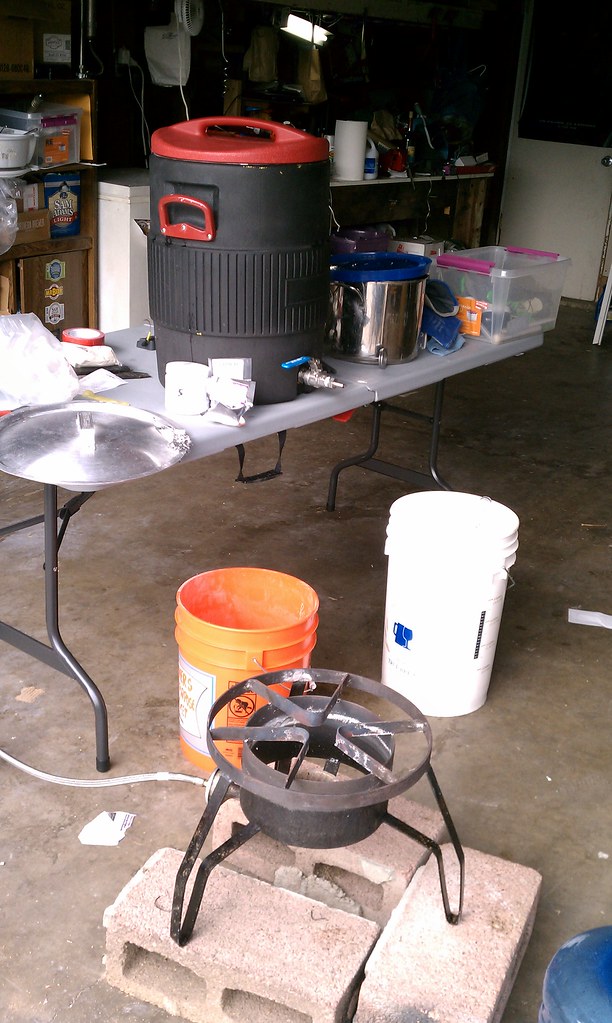 |
| Mashing |
Batch 3
Brewing up this beer again had been on my mind for awhile, but with a 15 gallon keg of the Karl Strauss version in the Crate I was in no big rush. The two month brewing hiatus also didn't help and I was soon running low on beer. I have big plans for the beer in 2012 and felt that time was running out to make and test changes to the recipe. It is after all a 10 week batch cycle for this beer.
I had in stock or had access to all the key hops I would need for this beer with the exception of Amarillo. I decide to play around with the recipe and substitute the Amarillo with Citra, one of my favorite hops. I also wanted to incorporate it into a flavor addition and I didn't want to just add it and change the IBUs so I adjusted some of the other hops to keep everything in line.
The biggest change I made was skipping moving the recipe to Partial Mash and going all out and converting it to All Grain. Good idea? Bad idea? I'm always telling people there is no reason to rush the process until you are ready to make the jump to the next step, yet here I am with only 5 Partial Mash and 1 All Grain under my belt taking the recipe for my best known beer and converting it up. In retrospect I really haven't decided either way. I know I have a lot still to learn on water and steps to increase my efficiency but it was fun.
The brewday itself was pretty good. I got an early start with preheating my tun and setup complete around 7:30 am. My mom was in town so she helped off and on in between helping my wife out with our daughter. Originally I was going to opt for a shorter mash after having had a conversation with Brad that for the most part conversion occurs around 20 minutes due to increased efficiencies in the malting process of the grains. I ended up mashing for over an hour as I decided to take my daughter and BrewDog for a walk to the park for a game of chuck it and fun on the slides.
I was pretty off on my gravity so I need to do some additional research on steps to improve it. Other than that it went pretty well, I did apparently buy a pound of light DME instead of a pound of rice DME so I sent my wife over the shop to grab it while I sparged. In retrospect I should have tossed it in to make up for the lower gravity. I hit all my hop marks and was down cleaning up in time for a late lunch.
Given the time involved and the house demand for it I'll probably only have this available at the brewery. I'll plan a release tasting sometime in December if it comes out good.
Cheers
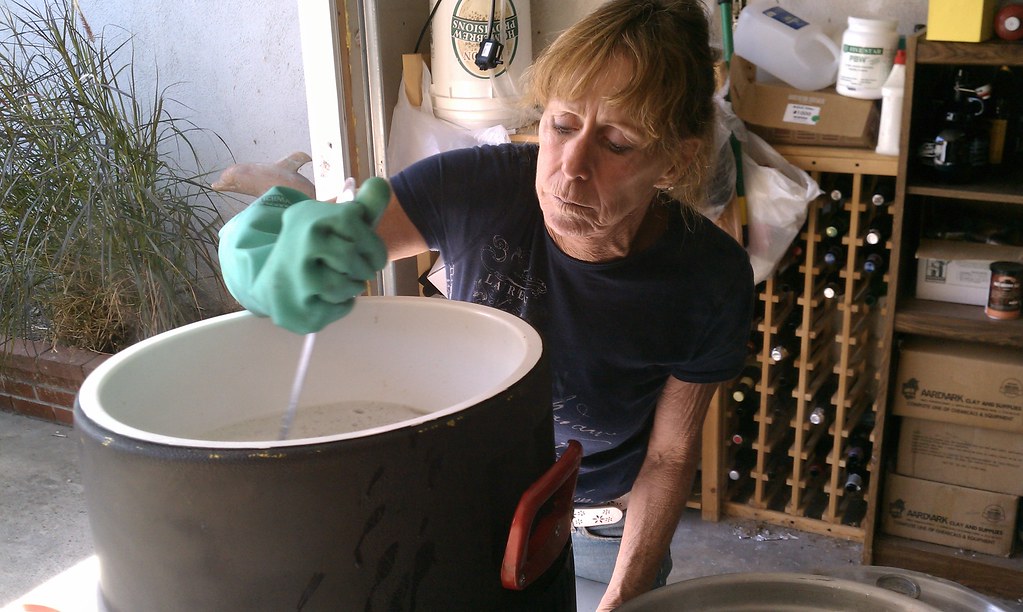 |
| My mom stirring the mash during the sparge |
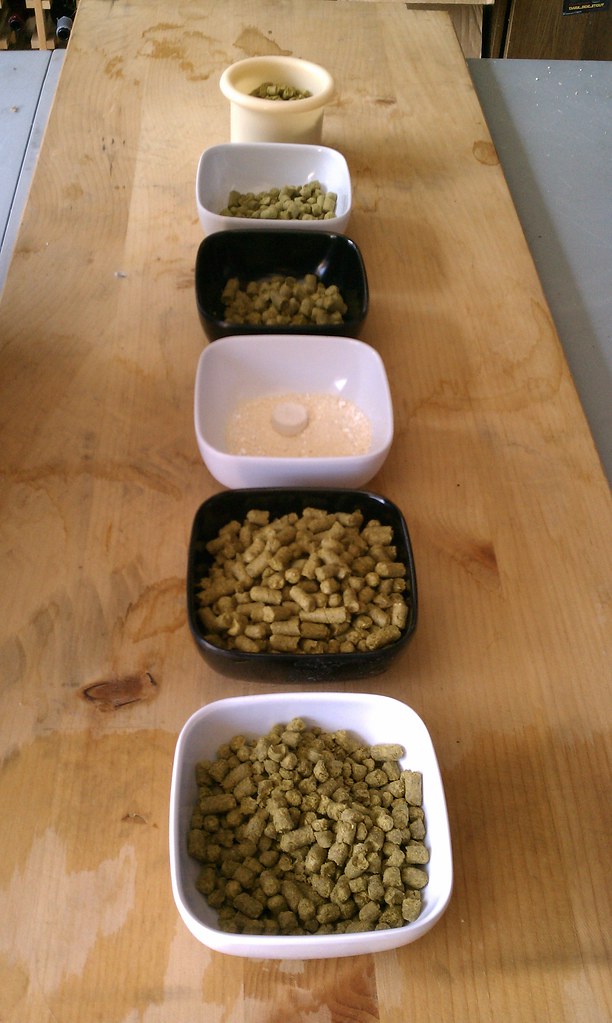 |
| Hop lineup |
Given the time involved and the house demand for it I'll probably only have this available at the brewery. I'll plan a release tasting sometime in December if it comes out good.
Cheers
-SNB
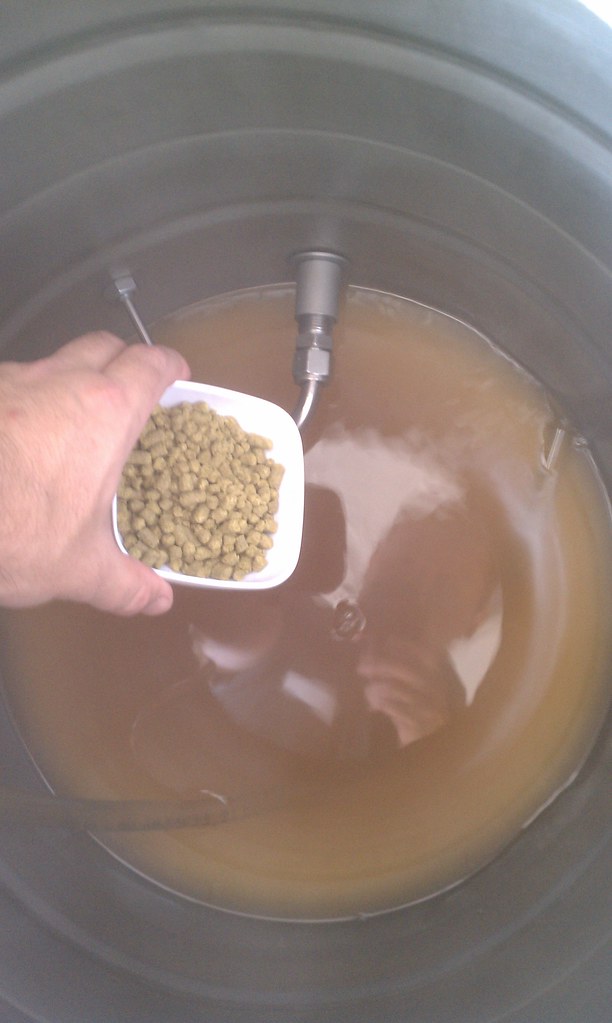 |
| First Wort Hops |
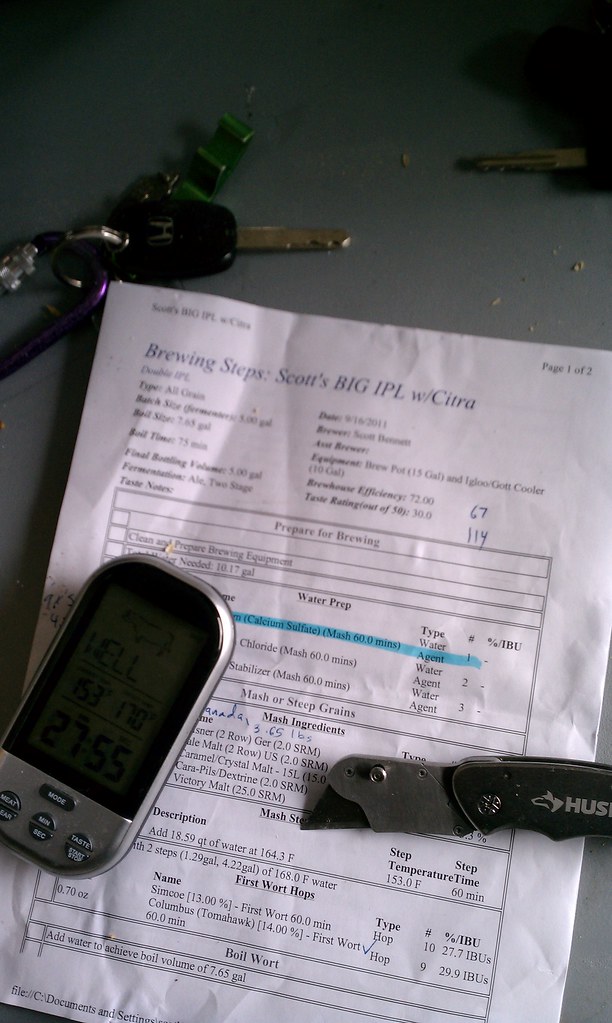
Scott's BIG IPL w/Citra
Double IPL
Type: All Grain
Date: 9/18/2011
Batch Size (fermenter): 5.00 gal
Brewer: Scott Bennett
Boil Size: 7.65 gal
Asst Brewer: Marianne Bennett and DG (BrewDog)
Boil Time: 75 min
Equipment: Brew Pot (15 Gal) and Igloo/Gott Cooler (10 Gal)
Brewhouse Efficiency: 72.00 % - ended up much lower at 60.3%
Fermentation: Scott's IPL Lager
Beer Profile
Est Original Gravity: 1.082 SG
Measured Original Gravity: 1.071 SG
Est Final Gravity: 1.017 SG
Estimated Alcohol by Vol: 8.7 %
Bitterness: 108.5 IBUs
Est Color: 6.7 SRM
Ingredients
Malt
8 lbs Pilsner (2 Row) Ger (2.0 SRM)
4 lbs 12.8 oz Pale Malt (2 Row) US (2.0 SRM)
1 lbs Rice DME (7.0 SRM)
8.0 oz Victory Malt (25.0 SRM)
8.0 oz Caramel/Crystal Malt - 15L (15.0 SRM)
8.0 oz Cara-Pils/Dextrine (2.0 SRM)
Hops
0.70 oz Columbus (Tomahawk) [14.00 %] - First Wort 60.0 min
0.70 oz Simcoe [13.00 %] - First Wort 60.0 min
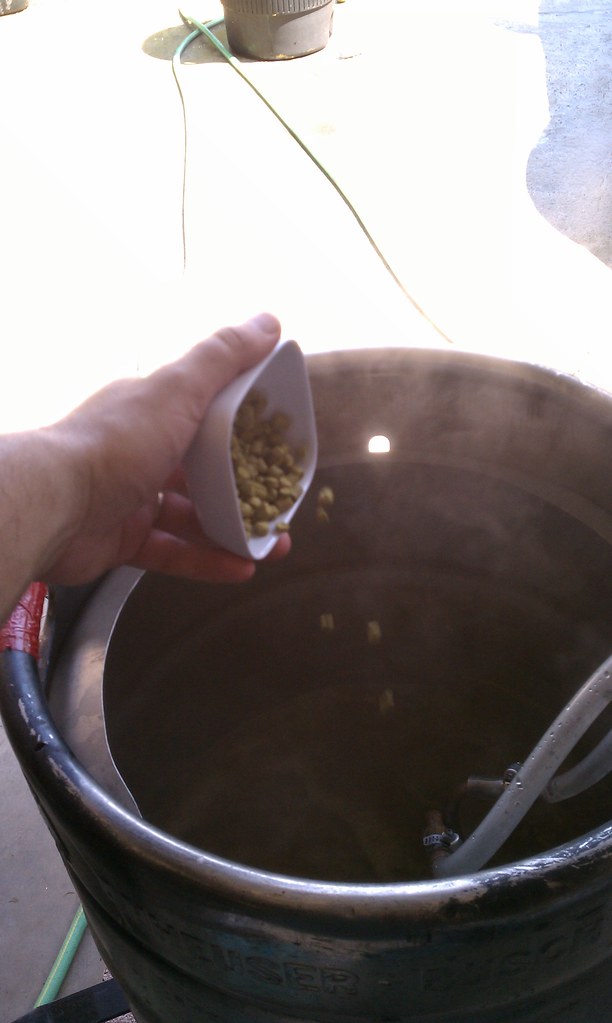
0.75 oz Citra [12.00 %] - Boil 17.0 min
0.75 oz Centennial [10.00 %] - Boil 17.0 min
0.75 oz Simcoe [13.00 %] - Boil 17.0 min
 |
| 17 minute addition |
0.70 oz Columbus (Tomahawk) [14.00 %] - Boil 7.0 mi
0.75 oz Centennial [10.00 %] - Boil 5.0 mi
1.00 oz Citra [12.00 %] - Boil 0.0 min
Dry Hops
1.00 oz Columbus (1st Dry Hop) [14.00 %]
1.00 oz Cascade (1st Dry Hop) [5.50 %]
1.00 oz Citra (2nd Dry Hop) [12.00 %]
1.00 oz Simcoe (2nd Dry Hop) [13.00 %]
Yeast
1.0 pkg American Lager Yeast (White Labs #WLP840)
Other
1.00 tbsp PH 5.2 Stabilizer (Mash 60.0 mins)
10.00 g Gypsum (Calcium Sulfate) (Mash 60.0 mins)
5.00 g Calcium Chloride (Mash 60.0 mins)
1.00 Items Whirlfloc Tablet (Boil 15.0 mins)
1.00 tsp Yeast Nutrient (Boil 15.0 mins)
 |
| 7 minute addition |
Mash Profile
Mash Name: Single Infusion, Medium Body, Batch Sparge
Total Grain Weight: 15 lbs 4.8 oz
Sparge Water: 5.52 gal
Sparge Temperature: 168.0 F
Mash PH: 5.20
Mash Steps
Mash In Add 18.59 qt of water at 164.3 F 153.0 F 60 min
Sparge Step: Batch sparge with 2 steps (1.29gal, 4.22gal) of 168.0 F water
Fermentation Schedule
Primary for 10-12 days at 55.0 F until fermentation slows
Diacetyl Rest for 2 days at 65.0 F
Secondary for 14 days at 50.0 F ending at 45.0 F
Tertiary for 21 days at 45.0 F ending at 40.0 F
 |
| Knockout |
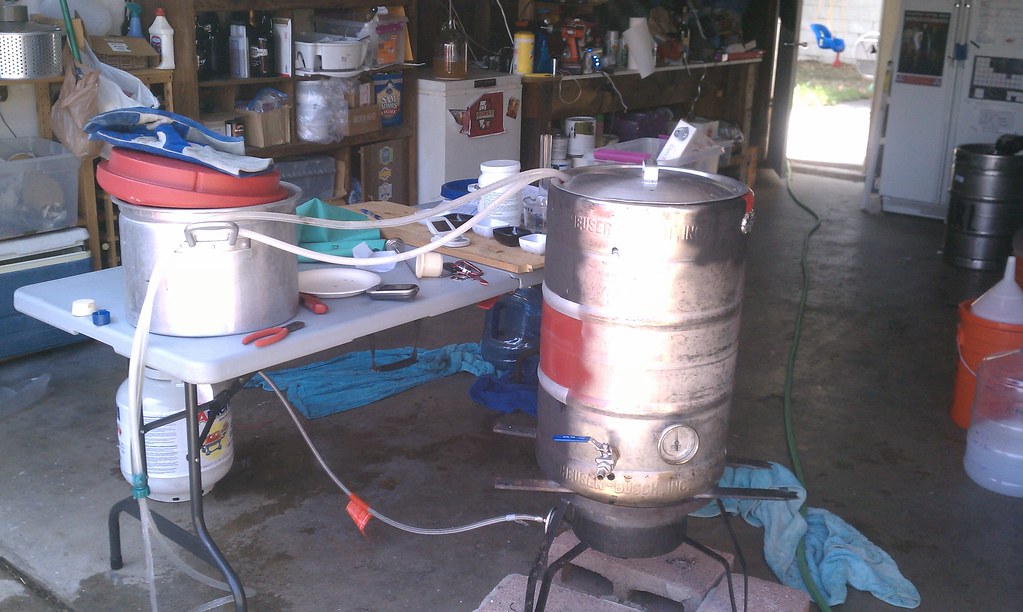 |
| Cooling down |
 |
| Moving to the fermentor |
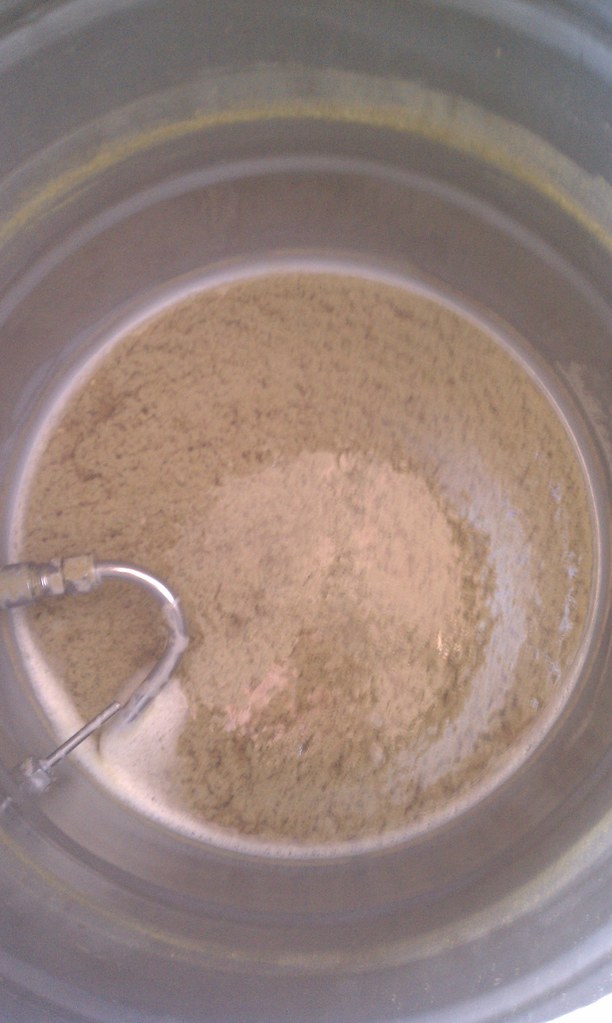 |
| Leftover hot break and spent hops |
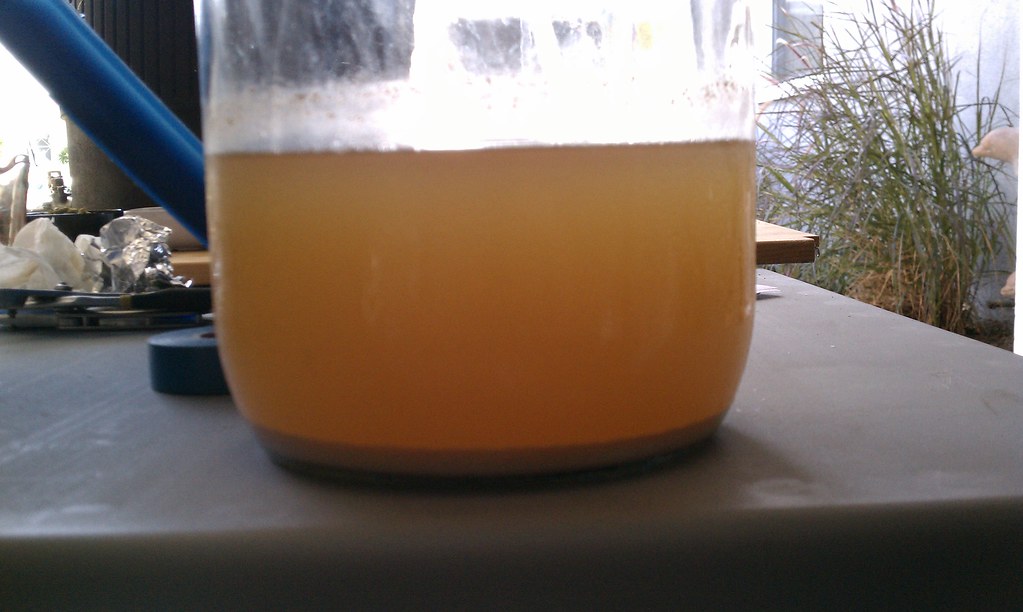 |
| Good amount of yeast |
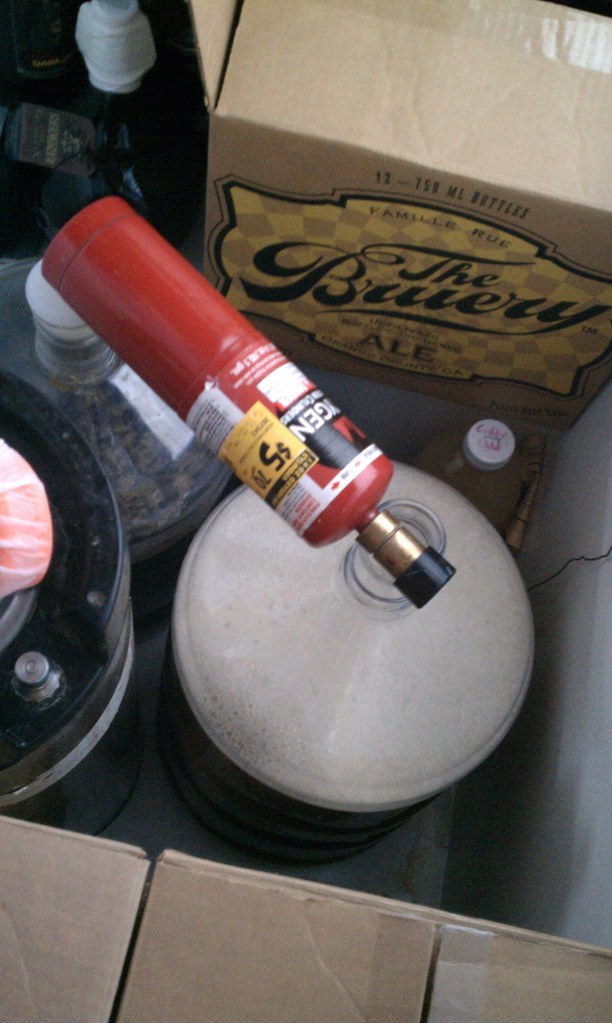 |
| I hit it with O2 three times in 6 hours |
Subscribe to:
Posts (Atom)
