Header Image

Showing posts with label StarRaptor. Show all posts

Tuesday, December 20, 2011

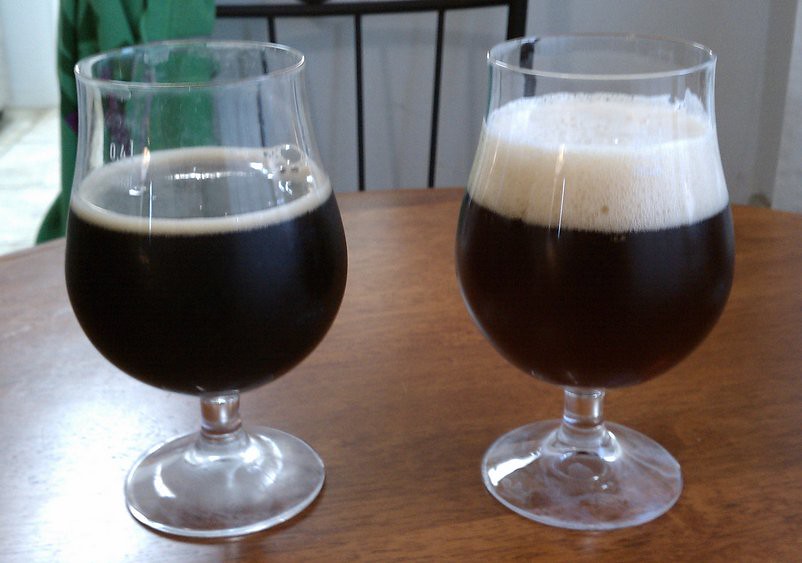
StarRaptor / Chris's Imperial Red - Side by Side

Same grain, different levels of hops
If you go back to the original post on StarRaptor you'll see that it started out as a collaboration brew on the Mr Beer Forums between myself and a fellow brewer out in Minnesota named Chris (mnstarzz13). 

The process itself is everything I love about a collaboration which in the end produced two very different beers. Essentially we arrived at a central grain bill which each of us spun to their own taste. For me this meant increasing the IBUs and adding some dry hops while Chris backed off the hops and created a much more malty beer. I also subbed the Amarillo for Citra which is something I will not do again if Simcoe is involved. As far as yeast went he used Wyeast's 1056 (which is the same strain as WLP001 and US-05) and I used San Diego Super Yeast (WLP090) which is described as supercharged WLP001, so pretty similar strains.

There was also a slight variation in equipment and techniques. The two that stood out for me was secondary vs non-secondary and keg vs bottle conditioned. Beyond those we both used a yeast starter, added yeast nutrient, included whirlfloc, controlled fermentation temperatures and aerated the wort (whip vs pure O2).

Chris's Imperial Red

Nice, dark garnet color
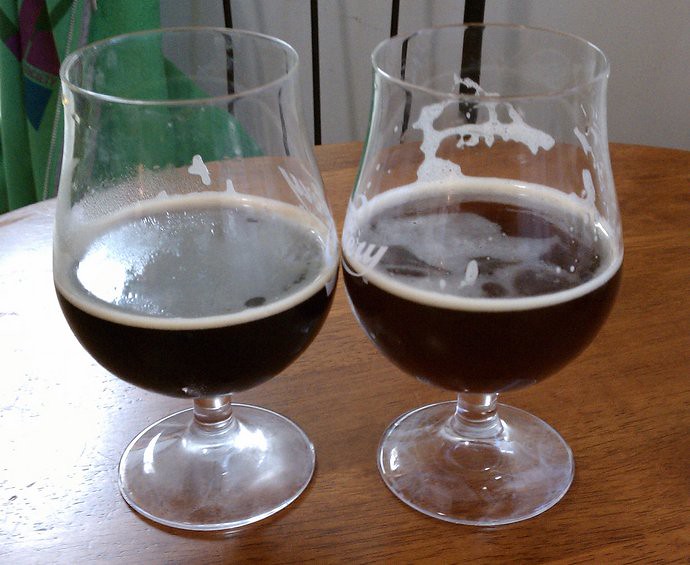
Appearance: Pours a dark garnet color into a Bruery tulip glass.  It appears slightly hazy as I shine a light through it but it is overall pretty clear for a bottle conditioned beer.  I poured it almost straight down and had issues generating head,  however when I swirl it I'm able to form a nice 3/4 inch head of tan fluffy foam. It's a lot darker then StarRaptor and when I shine a light behind it very little makes it through. Generates good lacing as I imbibe

Aroma: I'm picking up some slight wood, almost oak, notes.  I don't know where this is coming from.  It's very light on the hops coming across with a rich malty aroma.  When I breath in deep I get a slight fussel alcohol aroma.

Mouthfeel: Good level of carbonation with small tight bubbles.  Medium bodied with almost a rich think malty mouthfeel.

Taste: Very malty reminds me a little of an strong Irish red.  I can narrowly pick up the taste of the alcohol but it's very minor.  Overall it a smooth rich malty beer and when I look at it that was it is very drinkable.  There is very little hop bitterness as it is very malty. 

Overall:  This is a solid beer.  I feel it could have benefited with some time in secondary and perhaps some pure O2 at time of pitch.  It has a very familiar taste that I can't seem to place 
StarRaptor

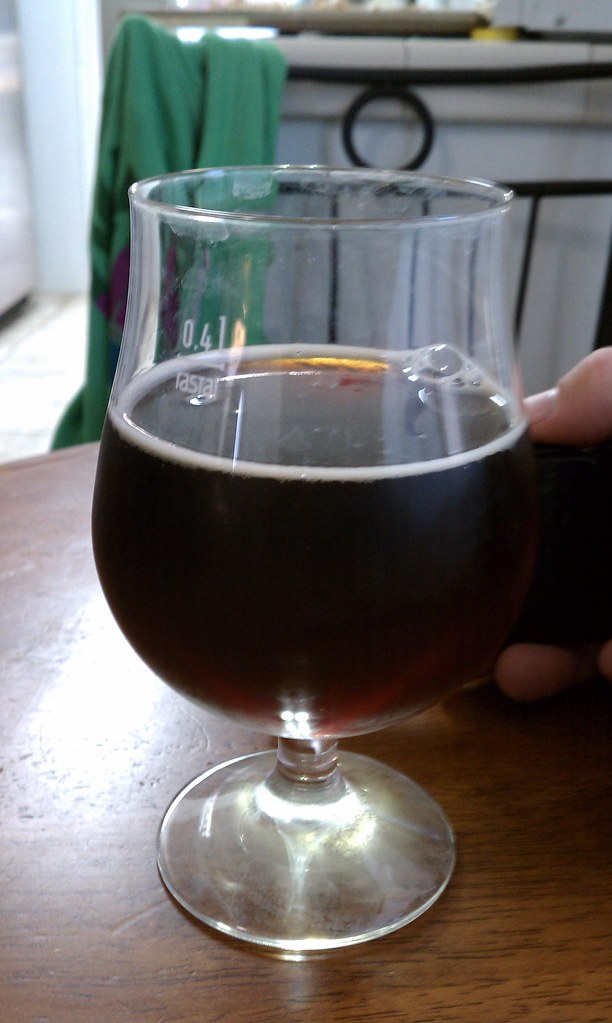
I love the color and the glow
Appearance: Poured crystal red from the tap into Bruery tulip glass with an inch of off white almost egg shell head. I'm actually pretty pleased and surprised by how clear it is. It's gone back and forth in the clarity department but seems to have leveled off pretty clear. Solid lacing as the level goes down. Shining a light behind it generates a beautiful red glow.

Aroma: Predominately citrus with some pine notes.  The Citra really stands out in the aroma, I just wish it played better in the flavor department.  It's been on draft for a while now I while the hops are still coming through it's days are numbered.

Mouthfeel: Light and crisp with OK carbonation considering the issues I'd recently had that flattened the keg.  In fact I had only re-carbonated it a couple of days prior.   I would consider it a light to medium bodied beer.

Taste: It seems to be improving and it very drinkable right now with nice citrus hop flavor.  I don't know how much longer this beer has before it completely fall apart though.  I don't think the hops are playing well and will avoid the Simcoe Citra combination in the future.

Overall: The most difficult thing about drinking this beer is shaking the memory of how it tasted when I was moving it to secondary.  It was absolutely brilliant and felt I had nailed a recipe.  Since coming out of secondary it has never lived up to that tasting.  Having had a few Simcoe Citra beers at this point I can say I don't like how they play together which is odd as Falconer's Flight is a hop blend of Simcoe, Citra and one other and I loved it in Costa del Sol.  I might play with this recipe and rebrew it in the future minus the Simcoe and I enjoy the Citra aroma it still has.

Cheers!
I really enjoy experiments and collaborations like this.  I find the ability to create multiple beers from a central batch of wort fascinating. The ability to take a grain bill and hop or add DME it to taste, in my opinion, really let's the individuality of the brewer shine through even more then when you just use different yeasts.  I hope to do more of these split wort collaborations in the future.

Cheers

SNB


Tuesday, December 6, 2011

BeerGunning the Imperial Rhino Stout 2011

Back in 2010 I made a big holiday beer out of some left over ingredients.  This was before I was doing starters, multiple early O2 infusions and yeast rousing.  It ended up being a pretty high alcohol beer at around 10.17% even if it was pretty sweet with a 1.026 FG.   I bottled it up in champagne style 750 ml bottles with some carb tabs.  In retrospect I should have added some fresh yeast as after several months most opened bottles were flat. 

One of my favorite pieces of brewing equipment
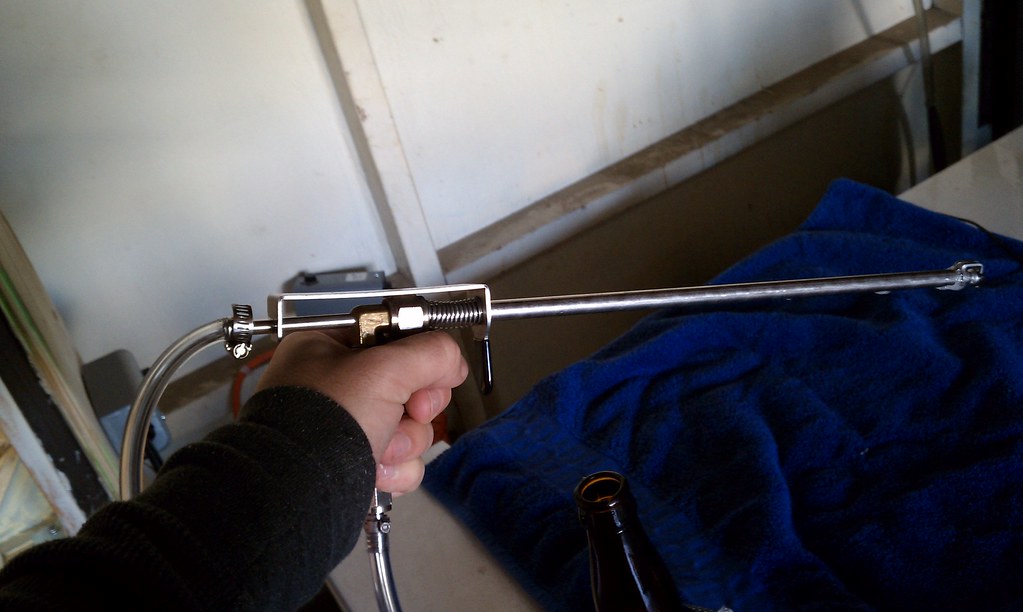
Salvation came that Christmas in the form of a Blichmann BeerGun.  A Blichmann BeerGun is like counter-pressure bottle filler in that allows you to bottle fully carbonated beer straight from a keg however unlike a traditional CP there is no need to pressurize the bottle to keg pressure.  It should be noted that I have filled bottles from both a corny keg as well as a sanke keg I just had to assemble a second set of connectors.  Basically it is a handheld version of a commercial bottle filler used in commercial brewing, Bootlegger’s actually uses two Blichmann BeerGuns to bottle all of their beers.

It should be obvious why bottling from a BeerGun is so great.  Basically it allows you to really dial in the carbonation level you want in the beer, eliminates concerns on carbonating high alcohol beers and there is no bottle sediment to cloud up my beer once poured.  I’m sure several people with disagree with eliminating all bottle conditioning potential of the beer but for the most part I’m not brewing the types of beers that benefit from bottle conditioning. 

I busted out the BeerGun both Saturday and Sunday this past weekend to fill some bottles.  The Saturday I only filled 8 bottles total; 4x 22oz Scott’s BIG IPL w/Citra to take to various events, 2x 12oz Scott’s BIG IPL w/Citra for the 2012 Doug King Memorial HomebrewContest next month and 2x 12oz StarRaptor to send to my collaboration partner.

The newest label for Scott's BIG IPL

Sunday was much different as I set out to drain a couple of kegs.  First up was the bottling of all remaining Imperial Rhino Stout 2011 into 12oz bottles.  Later this week I’ll label and wax them.  After that I filled a case of 22oz of Marshall’s bourbon barrel barley wine so I could get back the keg I’d lent him. 

The BeerGun is a great tool for any homebrewer to have in their toolbox.  It assembles and disassembles quickly for easy cleaning and works exactly as advertised.  It has two triggers, one flushes the bottle with CO2 to protect the beer from oxidation and the other fills the bottle with carbonated beer.  Once you flush and fill a quick sanitized crown goes on as usual.  The trick I’ve found to filling bottles with a BeerGun is to have the bottle and beer at roughly the same temperature.  You can chill the bottles two ways depending on time, in the fridge or if you’re in a pinch the freezer.  If I’m pressed I clean and sanitize the bottles then stick them in the freezer while I set up the bottling table.

I'll be back on Thursday to cover labeling and waxing the Imperial Rhino Stout 2011

Cheers

-SNB

Friday, September 30, 2011

In Progress Tasting

Marshall and I were talking the other day about how if we ever open a brewery we’d probably end up drinking 3/5th of it before it’s finished.  We say this because we find that we're constantly tasting our beers throughout the brewing process.  I can't fully speak for Marshall but generally I do this to check how the beer is progressing. While I rarely make mid fermentation changes but it does give me the ability to do so, for instances I can always add coco nibs or oak (both plain and spirit soaked).

Here’s a rundown of every phase of fermentation that I taste the beer.

The first place I do any tasting is actually while shopping for ingredients.  If I’ve never used a current type of grain before I general eat a couple of the kernels to get a general sense of the flavor profile it can add.  This method is actually how I started to employ both victory and carared.

Next up is while sparging, I’ll taste a little dab of the wort while I'm getting ready for my iodine test (no I don’t taste the iodined sample).  Here I’m looking to see if it has a sweet taste to indicate starch conversion has occurred.

Next comes after the boil is completed and the wort is cooled, I drink the hydrometer sample.  This is more tradition than anything else. At this point I have drank the hydrometer sample of every beer I’ve ever brewed (including the Karl Strauss batch).  This is not a good gauge of the finished product as some of my smoothest and sweetest beers, such as my citra wheat series, have tasted 180 degrees different then they did at the hydrometer sample.

Checking the color, clarity and taste on
StarRaptor
After that I sample whenever I take gravity and during transfer to secondary (or tertiary).  This is a great opportunity for me to check color and clarity as well as getting a since how it’s coming taste wise.

For some of my bigger beers (such as Imperial Rhino Stout2011) or a funky beer (such as SNB can be CynicAle) I pull or thief samples purely to check the progress of the beer.  These types of beers generally have a pretty long conditioning cycle for the taste to end up where I want it. The last thing I want to do is start serving a beer too soon.

Generally I'll have another sample while I’m kegging it up and then several while I’m carbonating it to check the level of carbonation.

Here's some notes I made over the weekend when I sampled three of my beers in progress.

StarRaptor: Brilliant clarity and I’m loving the color, it’s a little darker than I was targeting but man it’s a nice garnet shade of red.  Still pretty fusel/hot (large alcohol presence) but it is mellowed out since the last time I had it.

SNB can be CynicAle: Tasted during transfer to secondary. Great straw color and the flavor is right around where I want it.  It’s shaping up to be a pretty interesting combo, very much an amalgamation of Cynic and BeanyTink.

Scott’s BIG IPL w/Citra: 1 week in hydrometer check sample.  The corrected hydrometer sample shows that it is currently sitting at 1.020 SG, not bad for a one week old double lager.  The taste is very bready but it has a nice nose and some good hop flavors.  Diacetyl rest started Wednesday morning and will last till I transfer to secondary and dry hop this weekend.

I hope you enjoyed this brief glimpse into my tasting insanity

Cheers

SNB
Related Posts Plugin for WordPress, Blogger...