Header Image

Showing posts with label BaseCamp Breakfast. Show all posts

Thursday, May 3, 2012

BaseCamp Dessert aka Bourbon-Vanilla

Breakfast on the Left
Dessert on the Right
Clear shift in color
Over the weekend I kegged up my two beers that started their lives as a split batch of porter.  They started this journey back in March as a 10 gallon batch of porter brewed specifically for SCHF.  Right out of the gate the Breakfast version of the beers I've been calling my BaseCamp series got over a pound of maple syrup but it wasn't until secondary that the other beer, name Dessert, started its story.

As I mentioned last time the base grain bill was inspired by Denny Conn's Bourbon Vanilla Imperial Porter, Dessert represents a slight variation on that original beer.  The beer started this process when I added 4 vanilla beans (the processing of which I botched) to secondary and set it aside to age and meld flavors.

After several weeks in secondary it was time to keg it up and finish the process.  During transfer I tasted some of the vanilla porter that it had become along the way, frankly I was blown away by how much I enjoyed it.  The vanilla was up front and a part of the beer but not in an overpowering way.  When I do this beer again I need to be careful on how I handle the bean remembering that the bulk of the vanilla guts went down the drain in the first attempt. 

Needed to get it transferred quick
so I transferred the at the same
time using two sets of equipment
When I came to add the bourbon I reviewed some notes of Denny's and found he used around 10 ml of bourbon per pint of beer.  For five gallons this came out to be was 400 ml or 13.52 oz which I rounded to 14oz.  For the bourbon I sent my wife to the store to pick some up for me, she came home with some Makers Mark.  This differs from the Jim Beam Black Bourbon that Denny uses but I've used it before and it's Eric from AHP's favorite brand.

I've been tasting the final blend over the last few days as I've been carbonating it and I've been digging the flavor balance.  I recently read an article by Denny "Recipe Formulation: A Road Map to Good Beer" in the latest issue of Zymurgy.  In it he details the process on how he created the recipe for this beer.  It started as his attempt to replicate the flavors he was getting from barrel aged beers without it touching a barrel.  I can see this when I taste the beer but would shy away from saying it's completely successful.  Then again this is my version not his so it could be an unfair judgement. Never-less it's a pretty damn tasty beer.

Now the update I know you've been waiting for - BaseCamp Breakfast aka Maple-Bacon-Coffee!  When we left this beer I had jammed a pound of oven cooked bacon into the secondary fermenter to dry bacon my beer.  3 weeks later the beer had taken on a slight bacon-ness in both flavor and aroma. At the time I'd been worried about getting the bacon out of the fermenter, fortunately the beer had broken down the bacon and it slid right out.  To finish the beer off I added coffee and a very slight amount of liquid smoke.  For the coffee I had to change to a different method as I lacked the time to to a cold extraction.  For a quick coffee boost I asked Bonnie to pick me up some espresso from Starbucks that I tossed straight in the keg.  Taste wise it is ok but long term I will still lean towards cold extracted coffee for beers that will be around longer then a weekend.

If you're hitting up Southern California Homebrew Fest this weekend try to stop on by both the Brewcommune and AHP Brewclub booths to sample both versions of BaseCamp Series 1.

Cheers

- SNB

Wednesday, April 25, 2012

BaseCamp Breakfast aka Maple-Bacon-Coffee

The bacon
I'll be kegging my SCHF Split Batch Porter this weekend so I thought I would present some updates.  If you recall from my original post I set out to brew 10 gallons of beer to split and create two different beers.  The next two posts will cover moving the beer to secondary and kegging them up.   In each post I will talk about what was done to both beers and will provide the recipe if you only wanted to make one version of it.  The first recipe I will provide is for BaseCamp Breakfast aka Maple-Bacon-Coffee.

Bacon and beer, two traditional male stereotypes but could they work together?  It is a question several breweries have set out to answers.  I first read about bacon in beer in Brew Your Own when I was first getting into brewing.  They highlighted San Juan Brewing Co in Washington as an early pioneer of the concept which I have not had the chance to try.  I have gotten a chance to try two bacon beers on opposite sides of good, Rogue's disaster in a bottle Voodoo Bacon Maple Ale and Funky Buddha's wonderful Maple Bacon Coffee Porter. 

The beans
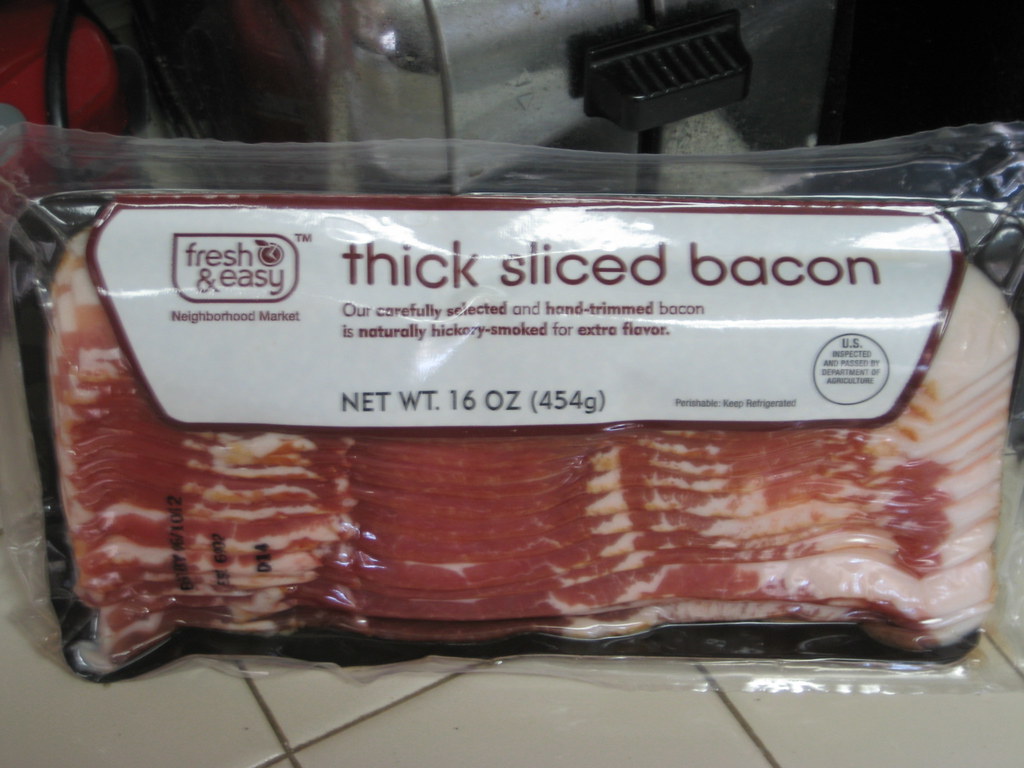
The premise behind adding bacon to beer is to add cooked bacon to secondary like you would hops. You want to cook off as much of the fat as possible so that you don't kill the head retention on the beer, something that fat does.  The technique that I used was to take a pound of thick cut bacon and cook it in my oven at 350 for an hour.   I used cooling racks over a broil pan so that the fat could drip down.  Once is was cooked I took paper towels and dabbed the surface to remove any additional fat.  I wrapped in a towel and set it aside.   If I did it again I'm going to cook it the same day I transfer and not before.

On transfer day I stuffed the bacon in a sanitized bag and submerged it in sanitizer.  I then jammed the sack into the secondary fermenter and racked the beer over it.  I have a bad feeling that it is going to be a pain to get out after kegging. The only thing that remains to be done is to brew up a batch of cold brewed coffee extract to add at kegging and toss in another 8oz of maple syrup.

Resting until kegging
The other beer half of the porter is on its way to becoming BaseCamp Dessert aka Bourbon-Vanilla.  BaseCamp Dessert as well as the base grain bill was inspired by Denny Conn's Bourbon Vanilla Imperial Porter. I put the recipe together by scrolling through about 89 pages of posts on Northern Brewer's forum to make sure I collected the best version. Let that be an insight to how I come up with recipes, I read - a lot.  I look for ingredients I'm familiar with, interesting ideas and most importantly feedback on how the recipe turned out.  This is also one of the reasons I like to post links back to where I'm looking at recipes, so that you can get a feel for what's out there,

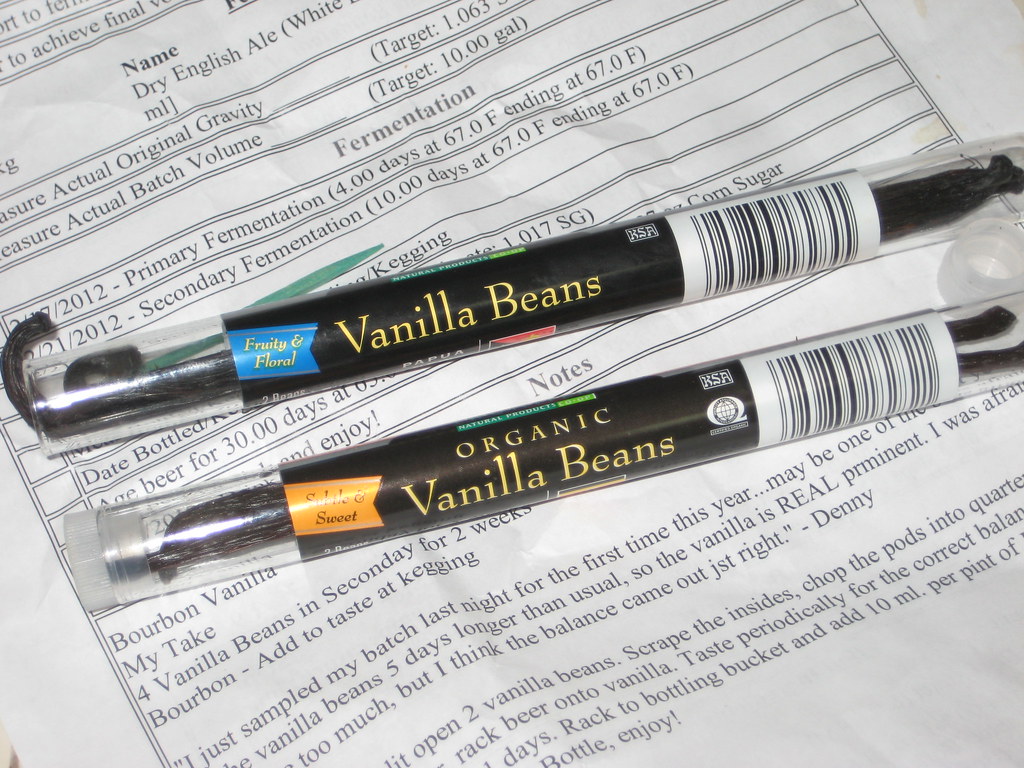
The first step in creating this was to source and prep vanilla beans. I picked up four vanilla beans from Whole Foods, two from Uganda and two from Papua New Guinea. To prepare them I took them and sliced them into sections and scraped out the filling. This is where I screwed up pretty big as I've never worked with them before.  When the directions called to scrape of the fillings I thought it meant to remove it, so I sent most of the good stuff down the drain.  I realized this toward the end so hopefully I'll get some flavor out of what I left behind.  I then tossed the beans into two clean and sanitized yeast vials with some tequila to extract the flavor. When it was time to transfer to secondary I dumped the entire contents of both vials into the transferred beer.  

The only thing left to do on this treatment is add some quality bourbon upon kegging by just pouring it in. No spirit soaked chips on this one my friends.  I'll cover all that next week.  One last thing, on the original post I mentioned plans for harvesting and washing the yeast for a house strain of WLP007.  I didn't do this because I didn't really like how the fermentation went starting with the starter.

Cheers

-SNB

Wednesday, March 21, 2012

SCHF Split Batch Porter

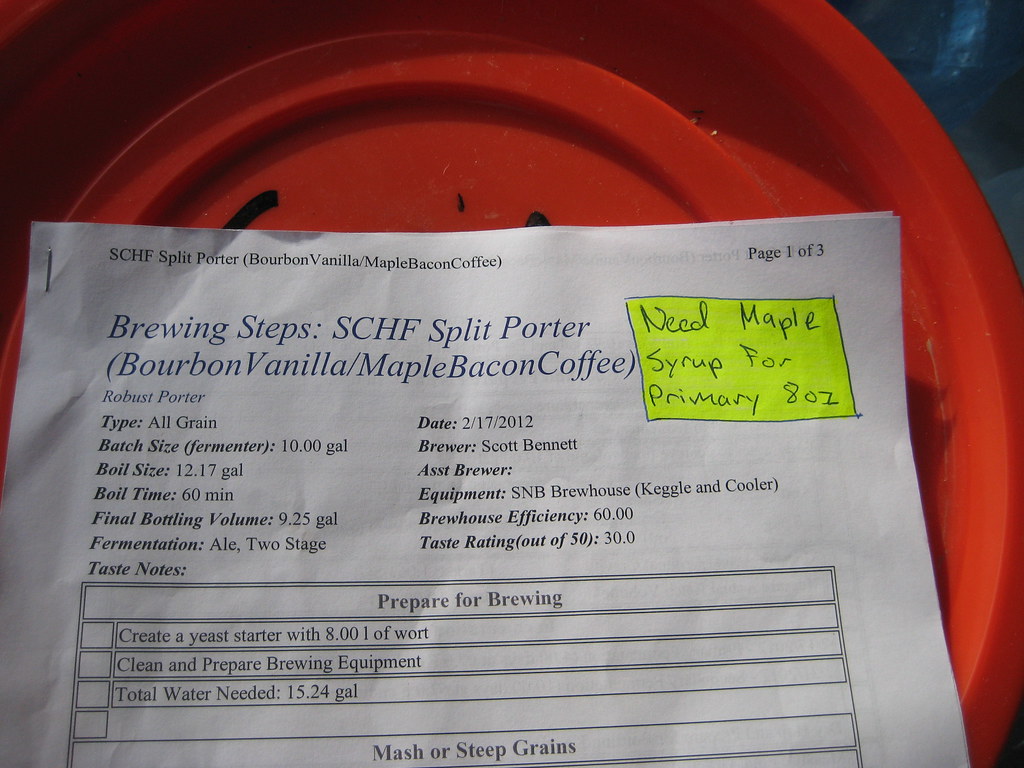
The brewsheet
In anticipation of this year's Southern California Homebrew Festival, taking place at Lake Casitas the first weekend in May, I set aside a Sunday to push my system to produce 10 gallons of beer with the plan on donating half to AHP Brewclub and the other to Brewcommune. When it came time to decide what to brew I had several ideas, would it be an IPL, a mild or bitter to be severed on cask or something completely new?

Last year took up 2 beers; an English-Belgian-American Double IPA that I called Scottland's Yard and a porter with 5 different kinds of peppers called Campsite Smoked Jalapeño Porter. Both beers were a hit and I got a lot of good feedback particularly on the Campsite Smoked Jalapeño Porter. It also happened to be the first keg to kick which I took as a good sign. I realized that I actually hadn't brewed a porter since then so I figured why not brew up a double batch of porter for this year as well


Assistant Brewer in training

If I was going to do it again I wanted to develop a base porter that I could use to create 2 different beers in secondary. To one half I plan on adding 4 vanilla beans in secondary and straight bourbon when I keg it, I am calling that batch BaseCamp Dessert and the other will become a porter with maple syrup, bacon and coffee called BaseCamp Breakfast. For BaseCamp Breakfast I have already added the first of 2 maple syrup additions by adding 18oz of maple syrup that I pasteurized while the main batch was cooling. The second addition will be used to prime keg. I will talk about what I will be doing to each batch more once I move them to secondary.

When it came time to brew the beer I started by making a starter of WLP007 that I could use one vial for all 10 gallons of beer.  My plan really was to make the primary of both beers pretty identical and really create two different beers in secondary so using the same yeast was a no-brainer.  I'm also hoping to be able to use the yeast from the Dessert portion to get a house culture of WLP007 going for this years Imperial Rhino Stout whose brewday is right around the corner. At around 7% the Dessert version is right at the upper limit for reusing yeast.

Overflowing with mash
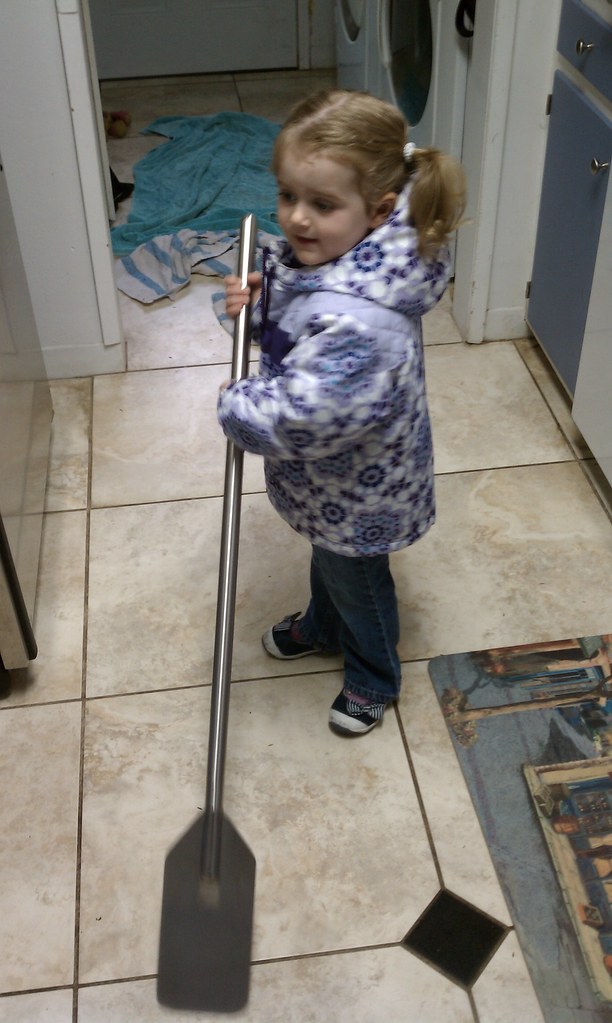
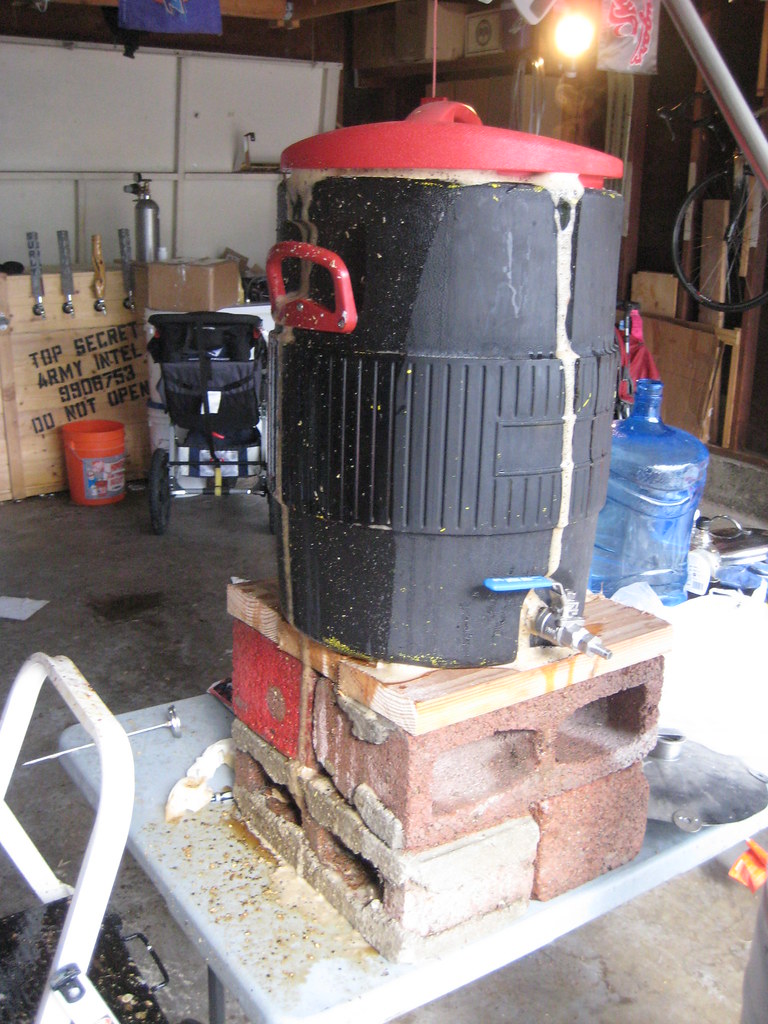
Brewing 10 gallons of the beer required the most amount of grain yet, even with the addition of 3 lbs of light DME I used so much grain that when I put the top on the mash tun the volume it displaced poured over the side.  Still after 60 minutes I held a steady 154 temp, which was about 2 degrees under my target, and got full starch conversion. There was no way my stainless spoon was going to be able to handle the job so I few days before I brewed I used an Amazon gift card my brother gave me for my birthday to buy a 48" stainless paddle.  I had planned on buying a $10 wood paddle buy they had none in stock.  I love my new paddle, though I had to close the garage while stirring as I kept hitting it.

You might recall my frustration with the efficiency I'd been getting and more so to the point that even as I'd been lowering my efficiency I was still missing my target OG. I mentioned last time I brewed back in January that I had an idea where my problem was, my equipment settings.  Between then and now I spent some time looking at what variables others with similar equipment were using.  It turns out the default evaporation setting for a keggle (boil kettle made out of an old keg) was way off.  If I recall correctly it was set at almost 20% and when I looked online most people where getting 10%.  Adjusting this setting made all the difference in the world and I ended up with a 10 pt efficiency gain, pushing me into the 70s.  I also got to test out the refractometer that Shawn gave me when I bought his old grain mill. The flap is broken off but it still works great you just have to hold it in place.  I calibrated it against my hydrometer and ended the value in to the calibrate refractometer section of the brewing app I use.

Related Posts Plugin for WordPress, Blogger...